

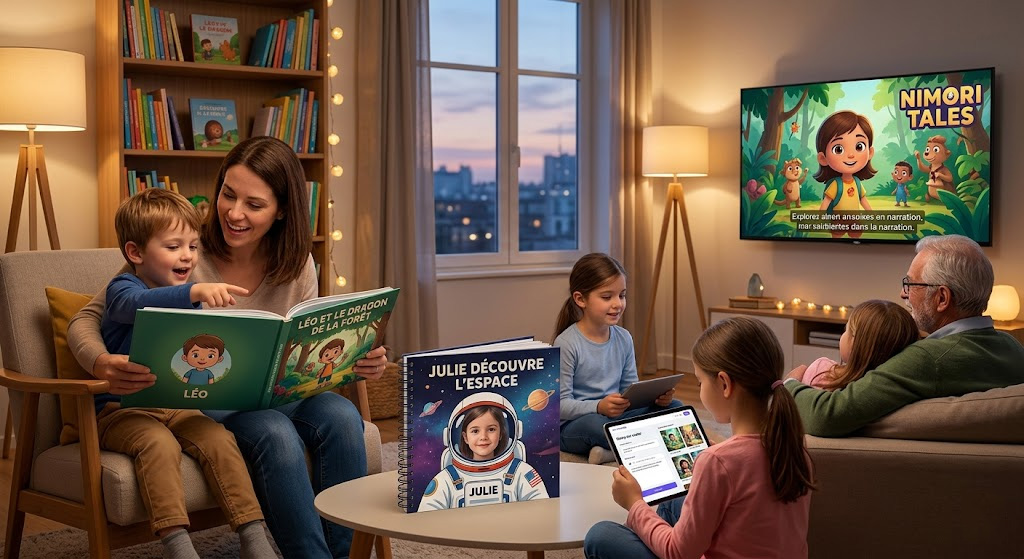
In short: Are you looking to transform bedtime into a truly magical adventure? The children’s book market has evolved considerably over the last few years. On one hand, the artificial intelligence revolution now makes it possible to generate entirely unique stories, complete with custom images and videos, thanks to completely free platforms like Nimori Tales. On the other hand, traditional publishing houses such as Wonderbly or Hooray Heroes are doubling down on gorgeous printed books featuring pre-designed avatars. To help you make the best choice for your little ones, here is a detailed, unfiltered overview of the existing solutions, complete with direct links to access them.
Why reading a story where your child is the hero changes absolutely everything
The bedtime ritual is a sacred moment, but for many parents, it can sometimes turn into a real obstacle course or a slightly monotonous routine. Telling a standard princess or knight story is great. But narrating an adventure where your child is the actual main character takes things to a whole new dimension. The identification is immediate, and the magic happens within seconds. When a little boy or girl hears their own name spoken out loud, sees their real-life friends unexpectedly integrated into the plot, or faces a challenge they encountered on the playground that very afternoon, their attention level skyrockets.
Narrative personalization is not just a fun little gimmick to impress your friends and family. It is a highly effective educational tool. It allows you to work on self-confidence, approach childhood fears with a lot of gentleness, and develop a sincere love for reading from a very young age. By placing the child at the center of the plot, we show them that they are capable of overcoming real-life obstacles. The big question today is therefore no longer whether to opt for personalization, but rather which technology to use to achieve the most stunning result that best suits your family’s daily life and budget.
Dynamic AI creation: absolute custom-made storytelling for their imagination
Artificial intelligence has completely reshuffled the deck in the children’s publishing sector. The days of basic “fill-in-the-blank” texts, where we merely replaced a first name in a static database, are over. Today, the story simply does not exist before you ask for it. It is generated in real-time, structured according to your own criteria, and designed to meet a specific need at that exact moment.
Nimori Tales: the free app that literally brings tales to life
This is undoubtedly my absolute favorite of this selection. Nimori Tales offers a completely novel, refreshing, and above all, 100% free approach. Unlike the majority of its competitors, which are limited to replacing variables, the platform does not just add a first name: it invites you to genuinely co-create the adventure from start to finish.
The concept is brilliantly simple. You enter the child’s name, but you can also add the names of their real friends, define a specific and highly personal challenge they need to overcome (such as fear of the dark, anxiety about going back to school, or potty training), and choose a moral value to impart to them. The AI then generates a unique story with great depth, perfectly adapted to their emotional situation at the time. But the great strength of Nimori Tales doesn’t stop at the text. The solution also generates beautiful custom images and captivating short video sequences to illustrate the story. It is the perfect interactive tool for daily use, without ever feeling the slightest guilt about your family budget.
Discover the platform: Official Nimori Tales website
MyKidStory: subscribing to a limitless world of imagination
If you want to go even further into pure visual integration, MyKidStory is a particularly interesting player to keep an eye on. This service, which operates on a regular financial subscription model, also uses AI to generate infinite texts. Its greatest technological strength? It integrates the real photo of your child’s face directly into the illustrations generated by the artificial intelligence system.
The result is often very impressive for toddlers, who immediately recognize themselves in fantastic settings, whether they are disguised as brave knights, astronauts exploring the galaxy, or jungle explorers. The site also allows you to order printed versions of these digital creations. However, you will need to plan for a substantial monthly budget, which makes this service more suitable for families of very regular and highly invested readers.
Discover the platform: Official MyKidStory website
Livre Magique: from a glowing screen to paper in a few clicks
Livre Magique very smartly positions itself as an excellent bridge between the digital world of AI and the physical world of traditional publishing. You upload a beautiful photograph of your child to their server, and the artificial intelligence takes care of writing the complete text and creating a harmonious graphic style for the entire story.
What I particularly like about this proposal is the great flexibility of the formats. Are you in a rush for tonight’s bedtime story and need an emergency solution? You can opt for immediate delivery in eBook format. Would you rather plan ahead for a beautiful birthday or Christmas gift? Have the bound version shipped directly to you, carefully printed on high-quality paper. It is an ideal compromise for technology lovers who still enjoy the smell of fresh ink.
Discover the platform: Official Livre Magique website
Publishing’s safe bets: traditional players and their avatars
Before artificial intelligence shook up the market’s codes, some fantastic publishers popularized the very concept of the personalized book. Their working method is different and relies on solid fundamentals: the story is written months in advance by professional children’s authors, and the user customizes a virtual avatar so that it physically resembles the intended child recipient of the book.
Wonderbly: the undisputed giant of premium printed books
This is the absolute pioneer of the sector, made world-famous by its essential bestseller “Lost My Name”. At Wonderbly, the personalized book is conceived as a true work of art. The stories are highly poetic, the hand-drawn illustrations by real artists are sublime, and the paper quality borders on editorial perfection.
The creation interface on their website is extremely well thought out and fluid. You configure the child’s avatar (haircut, skin color) in just a few clicks. Although the narrative remains strictly the same for all buyers of the same title, the indisputable beauty of the physical object makes it an ideal birth, Christmas, or christening gift, meant to be kept for a lifetime on a bookshelf.
Discover the platform: Official Wonderbly website
Hooray Heroes: making parents cry tears of joy and emotion
Hooray Heroes has understood one essential thing in terms of marketing and emotion: children’s books are often bought by parents, and primarily to please the parents. Their books spectacularly emphasize pure emotion, deep family bonds, and the intergenerational tenderness that unites a family.
Their computer tool for creating avatars is undoubtedly the most advanced in the classic market. You can adjust absolutely everything, from little freckles to the precise shape of the glasses, and above all, you can include the entire family dynamic. Adding mom, dad, siblings, and even the house dog or cat into the same pre-written story guarantees moments of great emotion when opening the gift wrap.
Discover the platform: Official Hooray Heroes website
Mumablue: facing the great fears of childhood with gentleness
With a graphic and philosophical approach very similar to that of Hooray Heroes, Mumablue stands out mainly through its highly targeted choice of educational themes. The brand offers sturdy books, printed with great care and designed to withstand the often rough handling of little hands, which address crucial stages in the child’s cognitive and emotional development.
Whether it’s calmly preparing for the arrival of a new baby in the family, going on an adventure with brave pirates to overcome shyness, or managing the little anxieties of everyday life, your child’s avatar is plunged into comforting, benevolent, and very familiar situations. A very beautiful approach to bibliotherapy for the youngest readers.
Discover the platform: Official Mumablue website
Imagitime: placing the child directly at the heart of the drawing
Imagitime takes a slightly different technical gamble compared to its direct competitors: that of photomontage. Rather than asking you to create a stylized, fictional avatar using drop-down menus, the platform asks you to provide a good-quality real photograph of your child’s face. The site then digitally crops it and inserts it into pre-existing illustrations.
The visual rendering has a very playful, almost handcrafted feel, which madly amuses children at all stages of reading. Seeing their real, everyday face stuck on the muscular body of a superhero in action or a savanna explorer always triggers bursts of laughter and guarantees immediate success with siblings.
Discover the platform: Official Imagitime website
My expert tips to make reading an unforgettable moment
Creating the perfect configuration or buying the best custom story is only the first step in the process of amazing your child. Here are some practical expert tips to make this shared time your and your little reader’s favorite moment of the day:
- Get them actively involved: If your child is over three years old, sit them on your lap in front of the screen during the creation phase. On a dynamic platform like Nimori Tales, choosing the evening’s challenge together, selecting the friends who will accompany them, and watching the generated videos becomes an awakening game even before bedtime. It is a full-fledged parent-child activity.
- Play with your vocal intonations: Do not just read the text in a monotonous and mechanical way. Whisper during moments of great mystery, use deep, booming voices for funny monsters, and take real dramatic pauses before pronouncing the child’s name to create maximum suspense and capture their attention.
- Adapt to the evening’s timing: Save the beautiful printed books, which are often a bit longer and more fragile, for quiet weekend or long holiday readings. Favor digitally generated stories, which are often shorter and highly modular, for stressful weeknights when time is tight and fatigue is heavily felt.
- Use the story as a dialogue tool: Once the book is closed or the screen is off, systematically ask your child what they would have done in the place of their paper hero when faced with the challenge encountered. It is an excellent way to loosen tongues, reassure them, and encourage them to express their own emotions from the past day.
Frequently asked questions about personalized stories (FAQ)
At what age does a child really understand that the book is about them?
While babies are naturally attracted to bright colors and the musicality of words from their very first months of existence, it is generally between 2 and a half and 3 years old that a child begins to truly understand that the character bears their own name. Around the age of 4, the identification process is total, narrative comprehension is optimal, and the magic of personalization works at 100%.
Is it technically complicated to generate a story with artificial intelligence?
Not in the slightest! Innovative platforms like Nimori Tales have been specifically designed to be used by the general public, including grandparents or people less comfortable with technology. You need absolutely no computer or prompting skills. All you have to do is fill out a very simple and intuitive web form (the first name, the list of friends, the chosen theme) and click a validation button. The AI takes care of all the complex creative writing and visual generation work in just a few seconds, directly from your web browser.
Are my personal data and my children’s photos protected online?
This is a perfectly legitimate and essential concern for any responsible parent today. Serious platforms in this sector respect very strict personal data confidentiality rules (GDPR). Sites that require uploading real photos to create photomontages (like MyKidStory or Imagitime) only use them to generate the ordered images and then quickly delete them from their secure servers. Never hesitate to take a look at their privacy policies or general terms and conditions of sale if you have the slightest doubt before validating the creation of your book.
Is it better to choose a free digital book or a beautiful paid printed book?
You don’t necessarily have to choose one solution over the other, because the two uses are actually very complementary in a child’s life. Giving a magnificent premium printed book from Wonderbly at Christmas, for a birthday, or a christening is an excellent, lasting gift idea that will physically remain in the family library for years to come. On the other hand, for the daily reading routine, for learning new moral values, or to help the child manage a little sorrow that happened at school that very day, the absolute free access, the immediate narrative relevance, and the responsiveness of a dynamic generative tool like Nimori Tales are quite simply unbeatable in the long run for accompanying your child’s growth.