


India’s digital ecosystem has officially left its awkward teenage years behind. The era of casual hobby blogs and dusty local web directories has made way for a serious commercial playground—one humming with razor-sharp D2C brands, lean SaaS tools, high-traffic content hubs, and automated micro-businesses quietly printing revenue in the background.
Naturally, all that building leads to the next logical question: how do you actually cash out?
Whether you’re looking to turn years of caffeine-fueled sweat equity into actual capital, fund your next obsessive venture, or simply hand the operational reins to someone with deeper pockets, you eventually hit the exit button. But that’s usually where the fun stops.
Try selling a digital asset in India today, and you’ll quickly notice the options are pretty uninspiring. On one side, legacy international brokers demand hundreds of dollars just to let you list—before quietly ignoring your business if it doesn’t boast a six-figure price tag—and then cheerfully help themselves to a 15% cut at the finish line. On the other side, throwing your life’s work onto generic classifieds feels like an open invitation to professional tire-kickers and shady DM negotiations.
There is a saner middle ground. If you want to sell a website in India, offload an established e-commerce store, or find a legitimate route to sell your website for free without giving away half your margin, this guide walks you through the entire playbook—from defensible valuations to an escrow transfer that won’t keep you up at night.
The Landscape: High-Demand Indian Digital Assets
Buyers seeking to acquire digital properties in the Indian market generally look for three distinct categories:
- E-Commerce & D2C Stores: Shopify, WooCommerce, or custom React/Node builds. Buyers look closely at order volume, unit economics, return-to-origin (RTO) rates, cash-on-delivery (COD) ratios, and relationships with 3PL providers like Shiprocket or Delhivery.
- Content & Affiliate Websites: Blogs and niche informational portals monetized via Google AdSense, direct ad placements, or affiliate programs (Amazon Associates India, vCommission). Evergreen traffic from organic search is the primary driver here.
- SaaS & Digital Tools: Micro-SaaS tools, WordPress plugins, Android companion apps, and API services solving specific workflows for Indian businesses or international audiences.
Valuing Your Digital Asset: How Much Is It Worth?
Before listing, you need a defensible valuation backed by hard data. In digital M&A, valuations rarely hinge on historical build costs or future potential; they are pegged directly to historical net earnings.
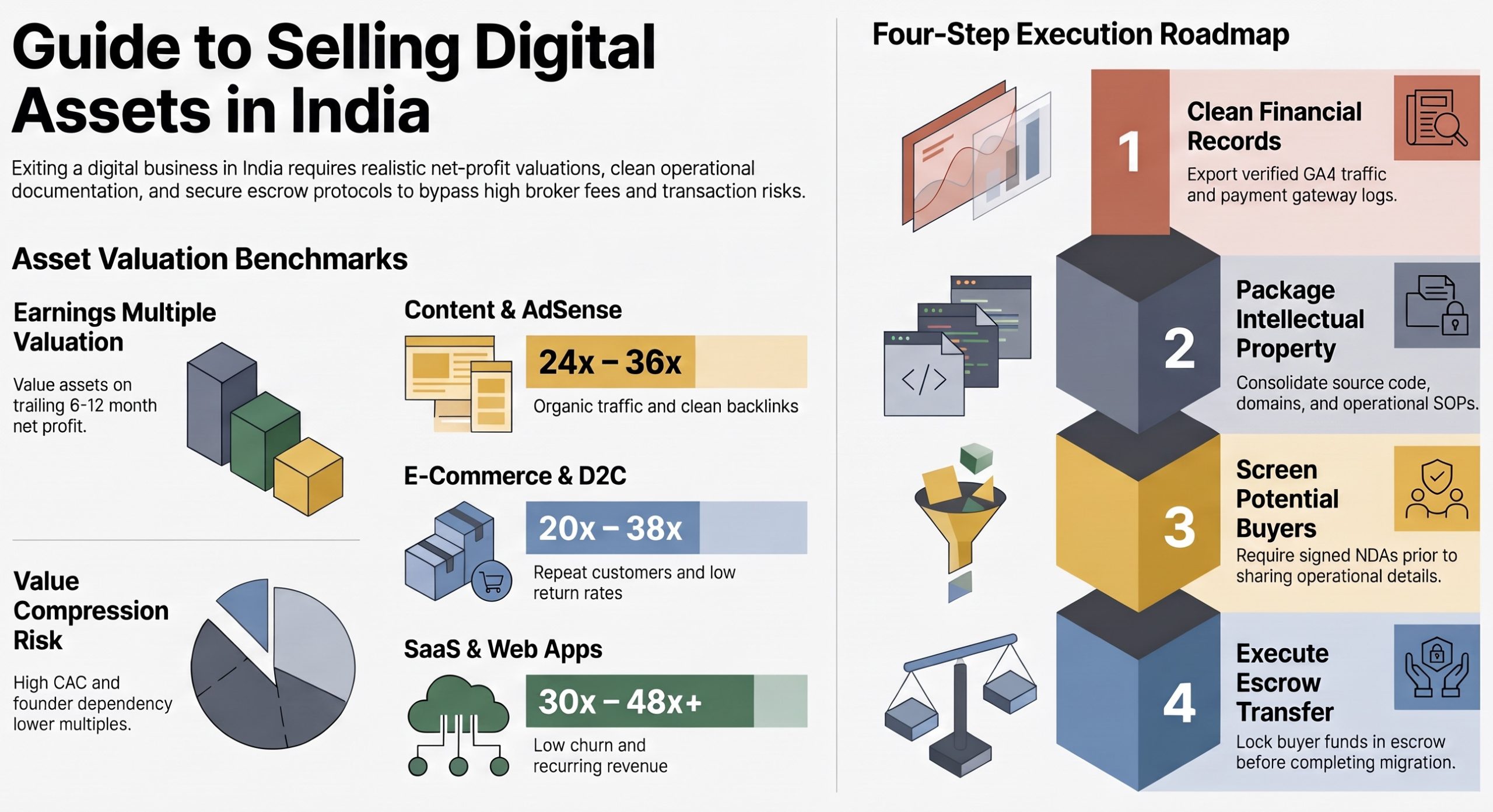
The industry-standard metric for small-to-medium digital businesses is Seller’s Discretionary Earnings (SDE) or Monthly Net Profit, calculated over a trailing 6 to 12-month period:
Valuation = Average Monthly Net Profit × Multiple
In India, typical valuation multiples range from 20x to 45x monthly net profit (equivalent to roughly 1.7x to 3.8x annual profit), depending on risk factors:
| Asset Type | Typical Monthly Multiple | Key Value Drivers |
| AdSense / Content Site | 24x – 36x | Organic SEO traffic, low backlink toxicity, stable niches. |
| E-Commerce / D2C | 20x – 38x | Repeat customer rate, low RTO, proprietary product lines, lean ad spend. |
| SaaS / Web Apps | 30x – 48x+ | Low churn (<5%), predictable MRR, documented codebase, automated ops. |
Factors That Compress Multiples in India
- High Customer Acquisition Cost (CAC): If your e-commerce store only generates revenue when running aggressive Meta or Google ad campaigns, buyers will apply a discount.
- Founder Dependency: If the business requires your personal face, manual supplier negotiations, or 40+ hours of custom maintenance a week, it becomes harder to sell.
- Platform Risk: Relying 100% on a single traffic source or affiliate partner introduces volatility.
Where to Sell Your Website for Free
Most legacy M&A platforms charge non-refundable listing fees ranging from $99 to $299 simply to make your asset visible. For bootstrapping Indian founders, paying upfront before a deal is even guaranteed represents unnecessary risk.
To sell a website for free, prioritize modern digital asset marketplaces that operate on a zero-upfront-fee model:
- Commission-on-Success Marketplaces: These platforms allow you to create a verified listing, upload analytics, and interface with buyers without opening your wallet. A transaction fee is deducted only when the deal successfully closes.
- Direct Professional Outreach: Engaging potential strategic buyers, competitors, or private investors via LinkedIn and indie founder communities. While this eliminates all marketplace commissions, it shifts the entire burden of contract drafting, due diligence, and financial verification onto you.
Step-by-Step Roadmap to Execute the Sale
Selling an e-commerce store or website requires a structured, step-by-step approach to protect your intellectual property and ensure seamless payment.
Step 1: Clean Up Financials and Analytics
Buyers will scrutinize your numbers. Prepare clean records covering the last 12 months:
- Traffic Proof: Grant view-only access to Google Analytics 4 (GA4) and Google Search Console. Never rely on static screenshots.
- Payment Gateway Reports: Export settlement sheets directly from Razorpay, Cashfree, PayU, or Stripe.
- Expense Breakdown: Tabulate hosting fees (AWS, DigitalOcean, VPS), SaaS subscriptions, supplier COGS, packaging, logistics, and ad spend into a clear monthly P&L sheet.
Step 2: Package the Intellectual Property
Document every component required to run the operation autonomously:
- Source code repositories (GitHub, GitLab) and technical architecture maps.
- Primary domains, regional TLDs (
.in,.co.in,.com), and trademark registrations. - Standard Operating Procedures (SOPs) for inventory management, content publishing, or server maintenance.
- Supplier and logistics contacts, including existing pricing tiers.
Step 3: Publish Your Listing and Screen Buyers
When listing your asset, highlight operational efficiency, year-over-year profit trends, and unexploited growth avenues (such as SEO expansion, entering quick-commerce, or introducing email automations).
Require prospective buyers to sign a Non-Disclosure Agreement (NDA) or prove liquidity before sharing sensitive customer databases, proprietary source code, or exact supplier names.
Step 4: Secure Escrow and Asset Handover
Never transfer assets based on a promise, a post-dated check, or a standard UPI screenshot. A secure sale must follow an escrow protocol:
- Agreement Execution: Both parties sign an Asset Purchase Agreement (APA) defining what is transferred, handover timelines, and post-sale support terms.
- Escrow Funding: The buyer deposits the full purchase sum into a licensed third-party escrow service (such as Escrow.com or a formal bank escrow). The funds are locked and verified.
- Asset Migration:
- Transfer domain ownership (ensure auth codes for
.indomains managed by NIXI-accredited registrars are processed correctly). - Transfer cloud hosting, database backups, and DNS records.
- Reassign social media profiles, admin access, and business email accounts.
- Transfer domain ownership (ensure auth codes for
- Inspection Window: The buyer is granted an inspection period (typically 3 to 7 days) to verify that site traffic, software code, and revenue match the agreed representations.
- Fund Release: Upon formal acceptance, the escrow agent releases the payout directly to your bank account via wire transfer or NEFT/RTGS.
Tax and Legal Considerations in India
Selling a digital business involves distinct statutory obligations under Indian commercial law:
- GST on Asset Slump Sale vs. Itemized Sale: Transferring an entire operational business as a “going concern” (a slump sale) generally does not attract Goods and Services Tax (GST). However, selling individual intangible assets (like standalone software code or domain names) may attract GST under intellectual property classifications.
- Capital Gains Tax: Profits generated from the sale of digital intangibles and website assets are subject to capital gains tax under the Income Tax Act. Depending on whether the asset was held for more than 24 or 36 months, gains are classified as Short-Term Capital Gains (STCG) or Long-Term Capital Gains (LTCG).
Always consult a Chartered Accountant (CA) to structure your transaction terms prior to signing the final purchase agreement.
Closing Thoughts
Exiting a web asset or an e-commerce store in India doesn’t have to mean handing over your firstborn to an offshore broker or praying that an anonymous buyer actually wires the money.
Once you swap messy bank statements for a clean P&L, ground your asking price in reality rather than wishful thinking, and take advantage of free-listing platforms that take escrow seriously, selling a business stops feeling like a high-stakes gamble. You poured endless late nights and absurd amounts of screen time into building the thing—cashing out should be the satisfying final chapter, not the stressful one.