


Selling a software-as-a-service (SaaS) business is fundamentally different from transferring any other digital asset. Unlike flipping a content site, an e-commerce shop, or a portfolio of domain names, a SaaS business derives its core value from a dynamic machine: actively maintained proprietary code, recurring subscription revenue built on customer trust, and an underlying cloud infrastructure that cannot afford even a single minute of downtime during ownership transition.
Whether you run a micro-SaaS generating a few thousand dollars a month or a mature multi-tenant platform, maximizing the final sale multiple and avoiding transaction pitfalls requires meticulous preparation, often several months before listing the business on the market.
1. Financial valuation: engineering your metrics ahead of time
SaaS valuations are nearly always calculated using a multiple applied either to annual recurring revenue (ARR) or to normalized net seller earnings, typically referred to as seller’s discretionary earnings (SDE) or EBITDA. For any serious buyer, every single dollar of proven, sustainable net earnings carries direct multiplier value.
Auditing and cutting operating expenses six months prior
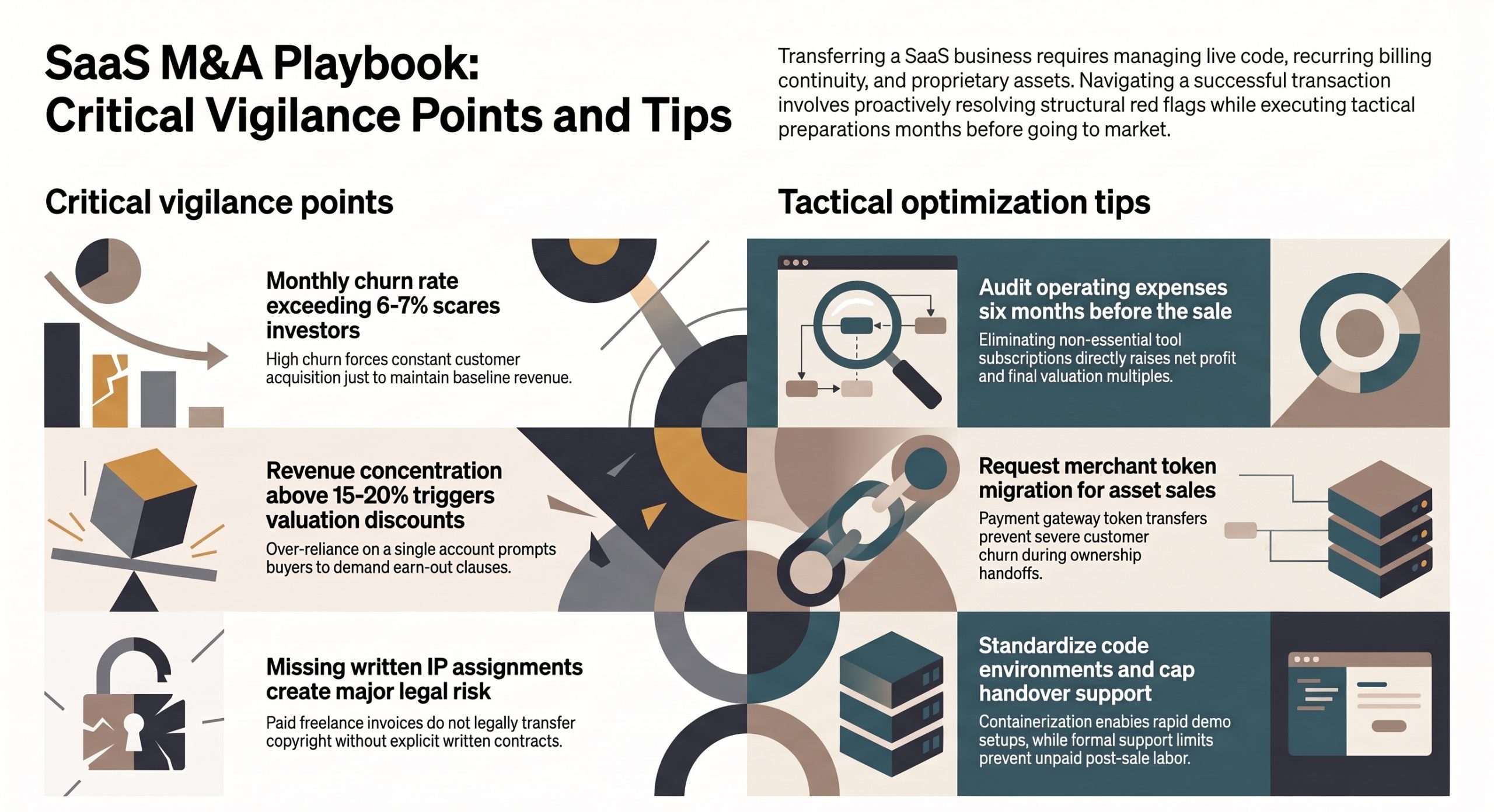
One of the highest-ROI tactics founders can implement before going to market is an aggressive audit of operational overhead. Over time, founders tend to accumulate forgotten marketing subscriptions, idle cloud instances, redundant staging databases, and third-party tools that are no longer strictly required. Canceling non-essential operational expenses immediately expands your bottom-line margin. At an average multiple of 4x net profit, saving just a hundred dollars a month can add nearly five thousand dollars in cash directly to your final sale price.
Securing revenue retention and reducing customer churn
A buyer’s primary concern during financial due diligence is customer churn. A SaaS showing monthly churn higher than 6% or 7% represents a treadmill business where the new owner must constantly reinvest in customer acquisition just to keep net revenue flat.
A proven strategy to optimize this metric prior to listing is launching an incentive campaign to convert month-to-month subscribers into annual billing plans using an attractive discount. This accomplishes three key goals: it brings in immediate upfront cash flow, dramatically lowers observed monthly churn rates, and provides the buyer with a reliable baseline of contracted users across their entire first year of ownership.
Customer revenue concentration requires equal vigilance. If a single enterprise customer accounts for more than 15% to 20% of your total ARR, expect the buyer to demand an earn-out arrangement or an escrow holdback to protect against that anchor account leaving shortly after the founder departs.
2. Intellectual property and source code due diligence
The core asset of a software business is its intellectual property. During technical due diligence, the buyer will thoroughly examine your codebase history to confirm that you hold exclusive legal title to every line of code and that the product can be transferred cleanly without litigation exposure.
Copyright assignment agreements with contractors and third parties
This is one of the most frequent deal-breakers during SaaS acquisitions. If you worked with freelance developers, independent contractors, or an agency to build parts of your application, paying their invoices does not automatically transfer intellectual property rights. Across both civil and common law jurisdictions, economic copyrights in software must be formally assigned in a written, explicit assignment contract. Missing IP assignments force last-minute scrambles to track down previous developers for signature, which can derail the entire sale.
Open source licensing compliance and dependency hygiene
Modern applications rely heavily on open-source packages, but licensing models vary considerably. Incorporating permissive libraries licensed under MIT or Apache 2.0 presents no issue. However, careless integration of reciprocal copyleft licenses such as GPL or AGPL can legally require you to open-source your entire proprietary application code upon distribution. Running an automated software bill of materials (SBOM) and dependency license check prevents unpleasant discoveries during the buyer’s technical audit.
3. Technical continuity and zero-downtime infrastructure migration
A professional SaaS transfer should be completely invisible to end users. Any server downtime, data corruption, or broken third-party webhooks during migration damages customer confidence right when the new owner takes the helm.
Containerization and automated deployment pipelines
A software product running on an idiosyncratic server setup with undocumented manual configurations scares off buyers or leads to steep price reductions. Wherever feasible, containerize your application using industry-standard tooling such as Docker, and provide clean automated deployment scripts along with a documented staging setup.
Deliver a clear README alongside a sanitized environment configuration template (.env.example). The prospective buyer or their technical advisor should be able to clone the repository and run a local instance within minutes.
Decoupling third-party service credentials early
Founders frequently make the mistake of tying transactional email services, managed databases, logging pipelines, and AI API keys to their personal email accounts. Well before listing the asset, migrate all external service ownership to generic role-based email addresses hosted on the product’s domain name. This enables clean, one-click credential handoffs without compromising your personal accounts.
4. Payment gateway continuity: the make-or-break hurdle
Subscription continuity is the operational heartbeat of a recurring revenue business. If your active subscribers must re-enter their credit card details because of an improper merchant account migration, you will experience catastrophic involuntary churn, often losing between 20% and 40% of your subscriber base within the first sixty days.
Tokenized data migration versus account ownership transfer
Two migration paths exist depending on how your acquisition is structured:
In an asset purchase, seller and buyer maintain separate merchant accounts, typically on Stripe. You should never attempt to handle raw credit card information directly. Instead, submit a formal Stripe-to-Stripe data migration request. Stripe’s compliance team handles the secure transfer of encrypted card tokens, customer profiles, and subscription schedules between the two accounts. This process usually takes ten to fifteen business days and ensures that recurring billings continue uninterrupted without client disruption.
In an equity purchase where the entire corporate entity is acquired, the transition is even simpler: you update the ultimate beneficial ownership details, corporate representative, and payout bank accounts directly within the existing Stripe account without touching active subscription schedules.
5. Deal structuring, escrow protection, and handover agreements
A successful sale relies on a legally binding agreement that protects both buyer and seller. Executing a comprehensive purchase agreement is essential to define the exact scope of transferred assets, representations and warranties, non-compete terms, and intellectual property assignments.
Securing closing funds via escrow
Never transfer domain name registrar locks, root server credentials, or GitHub repository admin permissions before full transaction funds are verified in neutral escrow. Whether using an online escrow platform or an attorney trust account, the closing process must follow clear milestones.
The buyer deposits the agreed purchase price into escrow. Upon confirmation, the seller delivers all technical assets, credentials, and codebases. The buyer then enters a contractual inspection window (typically three to five business days) to verify that the application runs as represented and matches production metrics. Once inspection is formally approved, funds are released to the seller.
Defining the post-sale transition and support scope
Buyers will almost always request post-closing onboarding support. To prevent open-ended commitments, explicitly define the handover scope in your purchase contract. Detail the exact duration (typically 30 to 60 days), weekly hourly caps, acceptable communication channels, and an agreed hourly consulting rate for any requests beyond that scope.
While SaaS handovers focus heavily on technical code transfers and server architecture, structuring the transition for a content-driven website or an e-commerce store requires a distinct approach centered around catalog migration, supplier handoffs, and media rights.
Preparing an operational playbook
To justify a top-tier valuation multiple, compile an operations manual covering common support troubleshooting steps, current roadmap priorities, top acquisition channels, and immediate growth opportunities. Providing clear documentation transforms a bare codebase into a turnkey commercial enterprise, giving the buyer the confidence to close quickly.








Converting monthly to annual plans before a sale is a clever tactic. It effectively buys you lower churn metrics and a cash injection right when you need the most presentable numbers.
I’m not sure a 4x multiple on net profit is standard for micro-SaaS under $5k MRR. In my experience, it’s more often 2x to 3x, and buyers push hard on churn when evaluating SDE.
The point about freelancer IP assignments being a deal-breaker is spot on. I lost a buyer once because a contractor hadn’t signed an explicit assignment clause and it took weeks to track them down.
Containerization is the single biggest quality-of-life improvement for due diligence. Any codebase I see that still relies on manual server configuration or brittle deploy scripts is an instant discount in my book.
The Stripe-to-Stripe migration is the scariest part for me. I’ve read horror stories about involuntary churn during handover. How responsive is their compliance team realistically for a smaller SaaS?
Revenue concentration is the silent killer. If one client is 20% of ARR, I won’t proceed without an earn-out. It’s simply too much risk for the buyer.
The $100/month saving equals $5k in exit value calculation is a nice motivator for founders. But don’t forget to account for the time cost of the audit itself.