

Macroeconomic Context and Overview of the African Internet Ecosystem
The African digital ecosystem is evolving within a complex macroeconomic environment in which the resilience of local economies is being severely tested by major headwinds. The African Development Bank (AfDB) has revised its forecasts for continental GDP growth downward, to 3.4% for 2023 and 3.8% for 2024. This slowdown results from a combination of global shocks, climate disruptions, persistent inflation, as well as the critical burden of debt servicing — particularly acute in major economies such as Ethiopia and Kenya — and high structural unemployment in Nigeria and South Africa.
From this perspective, an analysis of the Domain Name System (DNS) cannot be approached as a mere technical addressing issue. The DNS is the invisible yet fundamental lever of continental digital sovereignty, the development of the political economy of ICT, and the retention of local added value.
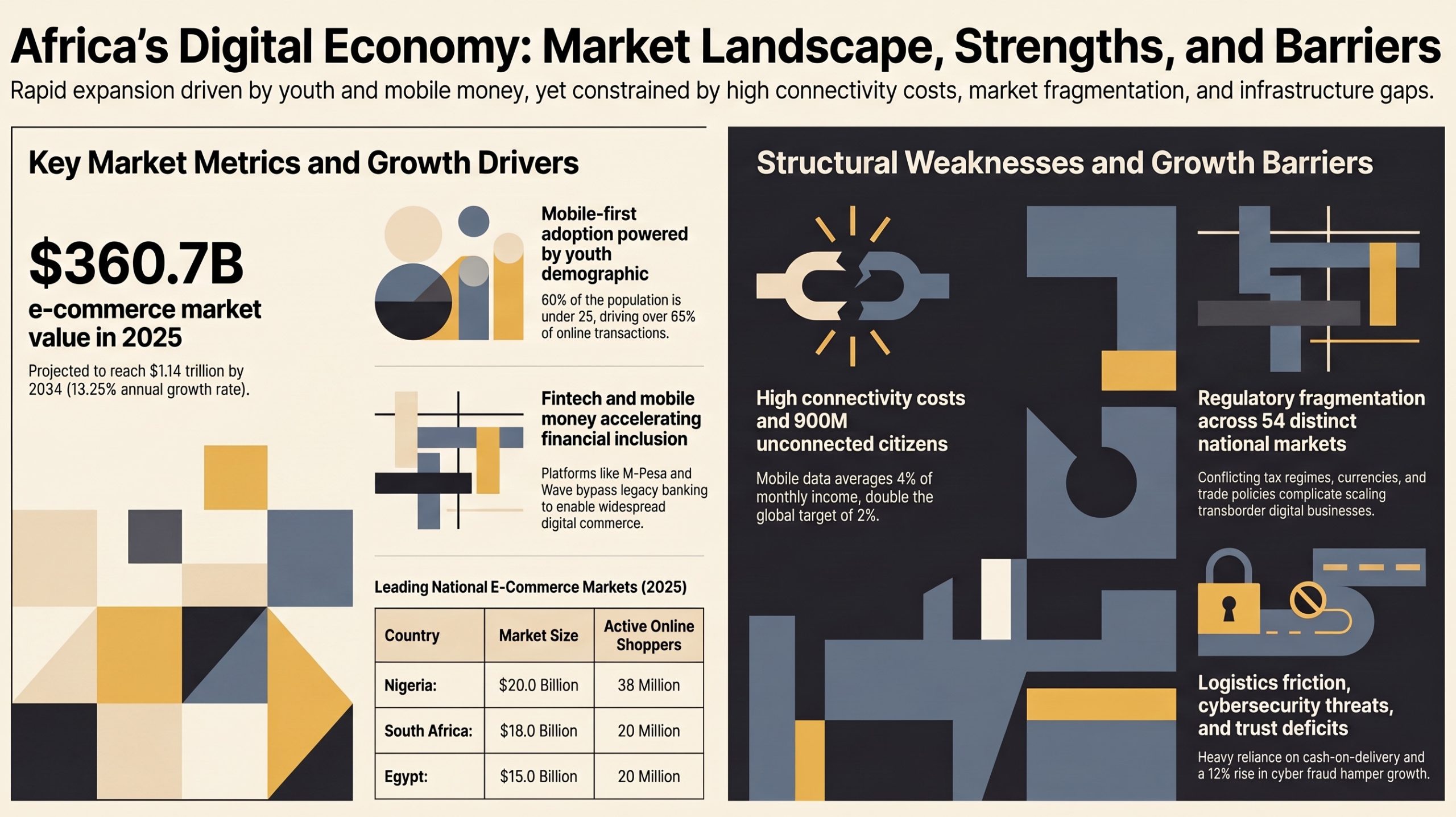
In terms of access, Africa has made significant progress: the number of Internet users increased from 4.5 million in 2000 to nearly 600 million in 2022. The penetration rate therefore rose from 29% in 2016 to 43% in 2022. Nevertheless, the continent still lags significantly behind the global average of 68.6%. This global average also conceals extreme disparities: penetration ranges from 6.8% (approximately 7%) in Eritrea to more than 83.8% in Algeria and 85% in Kenya.
These geographical disparities are compounded by structural differences in usage based on gender and place of residence. In 2020, the gender gap stood at 11 percentage points in Africa (24% of women connected compared with 35% of men), versus 5 points globally (57% compared with 62%). Similarly, usage rates rise to 50% in urban areas, while falling to just 15% in rural areas.
| Internet Usage Indicator (2020) | Africa | Global Average |
| Urban Areas | 50% | 76% |
| Rural Areas | 15% | 39% |
| Penetration – Women | 24% | 57% |
| Penetration – Men | 35% | 62% |
| Youth (15-24 years) | 40% | 71% |
| Rest of the Population | 27% | 57% |
| Overall Penetration | 33% (43% in 2022) | 63% (68.6% in 2022) |
Financial and logistical barriers continue to inhibit the creation of Web services and demand for domain names. The cost of mobile data remains a major constraint: for a monthly 1 GB data plan, the average African user must spend approximately 4% of their gross national income (GNI) per capita, twice the 2% ceiling recommended by the United Nations Broadband Commission.
Furthermore, Internet access on the continent is carried out almost exclusively through mobile devices using metered connections. This pay-as-you-go pricing model discourages prolonged browsing, slows the development of complex websites, and limits demand for domain names.
This economic constraint is compounded by the chronic lack of reliable electrification, which is essential for the continuous operation of base stations and digital infrastructure. As highlighted in the GSMA report Energy Challenges for Mobile Networks in Sub-Saharan Africa, the viability of networks and data centres depends on urgent access to clean and stable energy. In terms of logical resources, the continent suffers from critical under-allocation, holding only 2.4% of the world’s IPv4 addresses and 1% of its IPv6 addresses.
Nevertheless, underlying demand is set to be massive. According to Ericsson projections, smartphone mobile data traffic in sub-Saharan Africa is expected to quadruple by 2028, rising from an average of 4.6 GB per month per user (and 2.9 GB in 2021) to more than 18 GB to 19.5 GB per month.
At the same time, backbone infrastructure has been strengthened: terrestrial fibre-optic networks exceeded 1.1 million kilometres in 2022, and all coastal countries are connected to at least one submarine cable, with the sole exception of Eritrea, which also remains without cross-border terrestrial interconnection.
The interconnection ecosystem has also become more structured, with the number of operational Internet Exchange Points (IXPs) increasing from 36 in 26 countries in 2016 to 63 in 38 countries in 2023. There is a direct correlation between the density of IXPs and Data Centres in a country and the maturity of its local DNS market: IXPs enable local peering, reduce latency and international bandwidth costs, and provide the technical foundation required for in-country hosting.
The consolidation of these physical interconnection infrastructures directly determines the structure, economic value, and sovereignty of the domain name market in Africa.
2. Mapping, Volume and Financial Valuation of the African Domain Name Market
The DNS industry is a strategic asset for the economic development and digital sovereignty of African states. The reservation and use of national extensions (ccTLDs) or generic extensions (gTLDs) are not limited to a technical identifier: they provide the foundation for the online presence of businesses, the digitisation of public services, and the capture of value by local hosting and development service providers.
The continent’s top-level addressing space comprises 54 Latin-script ccTLDs, 6 Arabic-script extensions resulting from the Fast Track process for Internationalized Domain Names (IDNs) — assigned to Algeria (الجزائر.), Egypt (مصر.), Mauritania (موريتانيا.), Morocco (المغرب.), Sudan (سودان.) and Tunisia (تونس.) —, 3 geographic city extensions (.CAPETOWN, .DURBAN and .JOBURG), as well as the continental .AFRICA extension. Delegated to the South African ZA Central Registry (ZACR) with the formal support of the African Union, the .AFRICA extension has approximately 67,000 active domains.
At the end of 2023, the overall volume of domains registered under African ccTLDs reached 4.33 million. At the same time, African entities held approximately 1.4 million domains under gTLDs, the overwhelming majority (~1.2 million) under .COM. Although the total volume of ccTLDs has more than doubled (+203%) since 2016, the continental density of domain names remains marginal: Africa has an average of 3 domain names per 1,000 inhabitants, compared with a global average of 45 per 1,000.
================================================================================
KEY METRICS OF THE AFRICAN DNS MARKET (2023)
================================================================================
• Total volume of African ccTLDs          : 4.33 million (+203% since 2016)
• Volume of gTLDs held by Africans        : 1.40 million (including ~1.2M in .COM)
• DNS addressing density                  : Africa = 3 domains / 1,000 inhabitants
                                             World = 45 domains / 1,000 inhabitants
================================================================================
The economic assessment of the sector reveals significant gaps between the value directly captured on the continent and its overall potential. The analysis of ccTLD sales at prices charged by local registries represents direct revenue of USD 17.5 million. Applying average international prices, the theoretical value of these same ccTLDs amounts to USD 101 million. Adding the USD 16 million generated by gTLDs held by African residents brings the direct market to USD 137 million.
However, when applying digital ecosystem multiplier factors (including web hosting, website development, IT engineering consulting, digital marketing, and e-commerce services), the African DNS industry generates an overall economic value close to USD 1 billion.
This value is highly concentrated: 74% of continental revenues are generated by just 10 markets (South Africa, Nigeria, Morocco, Kenya, Angola, Tunisia, Somalia, Mauritius, Egypt and Zimbabwe/Uganda).
================================================================================
FINANCIAL VALUATION OF THE DNS ECOSYSTEM
================================================================================
• ccTLD market at local prices              : USD 17.5 million
• ccTLD market valued at international prices: USD 101.0 million
• Total direct market (ccTLD + local gTLDs) : USD 137.0 million
• OVERALL VALUE OF THE EXTENDED ECOSYSTEM  : ~ USD 1.0 BILLION
• Revenue concentration (Top 10 countries)  : 74% of total market
================================================================================
A structural problem lies in the location of hosting infrastructure and content. Of a total of 644 million African web pages indexed by Google, 66% are concentrated in just ten countries (South Africa, Nigeria, Egypt, Morocco, Kenya, Tunisia, Tanzania, Algeria, Mauritius, and São Tomé and Príncipe).
Above all, the continent faces massive data leakage through offshore hosting: in 41 African countries, more than 95% of gTLD domains owned by local entities are hosted on servers located outside Africa. This dependence on foreign infrastructure deprives local hosting providers of major revenues, worsens the foreign-exchange balance deficit, and degrades the user experience by imposing high latency caused by international traffic detours.
This heterogeneity in volumes and the hosting leakage make it necessary to rigorously and comparatively measure the performance of national registries.
3. Comparative Analysis of National Performance and Digital Maturity (CDSI)
To objectively assess the maturity and effectiveness of national DNS markets, the study applies the Country DNS Success Index (CDSI) methodology. The CDSI is a composite decision-making tool used to rank the 54 African countries and identify success factors as well as bottlenecks.
The CDSI is based on the weighting of 8 quantitative and qualitative criteria:
- The total volume of domains registered under the national ccTLD.
- The number of gTLDs held by local registrants.
- The volume of local web pages indexed by Google.
- The average registration price under the ccTLD.
- The number of registrars accredited by the registry.
- The percentage of websites actually hosted in-country.
- The presence and maturity of Internet Exchange Points (measured using the IXP Figure of Merit – FoM).
- The Internet penetration rate among the population.
The application of the CDSI highlights a group of structured regional champions. South Africa (.ZA) clearly dominates the continent with more than 1.2 million active domains, managed by a mature registry (ZARC) supported by a network of 622 accredited registrars. Other leading markets include Nigeria (.NG), Kenya (.KE), Morocco (.MA), Tanzania (.TZ), Tunisia (.TN), Egypt (.EG), Mauritius (.MU), Uganda (.UG) and Botswana (.BW).
The table below summarises the performance of the five leading continental champions across key ecosystem metrics:
| Country / ccTLD | ccTLD Volume (2023) | Number of Accredited Registrars | Local Hosting Rate / Status | IXPs & Key Infrastructure |
| South Africa (.ZA) | > 1,200,000 | 622 (ZARC) | Very high (predominantly local hosting) | Most developed ecosystem on the continent, major exchange nodes (JINX, CINX, DINX), world-class Data Centres. |
| Nigeria (.NG) | ~ 160,000 | Extensive network (Multiple) | Growing (Under strict NIRA governance) | Highly dynamic IXPN, submarine cable hub, rapidly growing local content. |
| Kenya (.KE) | ~ 100,000 | Extensive network (Local requirement) | High | Internet penetration >85%, major Data Centre hub in East Africa (KIXP). |
| Morocco (.MA) | ~ 55,000 | ANRT-accredited network | Moderate / Strong offshore gTLD presence | Regulatory framework structured by ANRT, linguistic sovereignty (IDN .المغرب). |
| Tanzania (.TZ) | ~ 27,000 | 72 | Developing (TCRA support) | Strengthened local interconnection (TIXP), advanced registry automation. |
Conversely, several national registries suffer from extreme underperformance and have fewer than 1,000 active domains: Eritrea (.ER – 80 domains), South Sudan (.SS – 209 domains), Comoros (.KM – 231 domains), Guinea-Bissau (.GW – 399 domains), Liberia (.LR – 503 domains), Guinea (.GN – 604 domains) and Niger (.NE – 947 domains).
Technical analysis of these markets reveals major operational deficiencies: lack of automated registrations via the EPP protocol (Extensible Provisioning Protocol), suspension of online registration procedures, manual processing on paper, lack of local hosting providers, and the absence of a commercial network of registrars.
Strategic Sovereignty Warning: The Risks of “Domain Hacks”
A poorly controlled outsourcing phenomenon has significantly distorted the statistics of certain African registries. ccTLDs such as Gabon (.GA), the Central African Republic (.CF), Equatorial Guinea (.GQ), Mali (.ML) and Libya (.LY) saw their volumes artificially inflated by entrusting management of their zones to offshore third-party operators (notably Freenom or SafeCow). These actors offered free or very low-cost registrations in order to capture redirected international traffic or exploit linguistic opportunities (domain hacks).
The recent collapse of these partnerships caused these fictitious volumes to disappear abruptly: Gabon fell from 690,000 .GA domains in 2017 to just 5,000 in 2023, while Mali fell from 240,000 .ML domains to 8,000.
================================================================================
SOVEREIGNTY WARNING: COLLAPSE OF OUTSOURCED REGISTRIES
================================================================================
• Gabon (.GA) : 690,000 domains (2017)  ==>  5,000 domains (2023)
• Mali (.ML)  : 240,000 domains (2017)  ==>  8,000 domains (2023)
--------------------------------------------------------------------------------
STRATEGIC RISK: Outsourcing the management of a ccTLD to offshore third parties
without transferring technical expertise, without local governance, and without
an economic model based on actual costs exposes the state to the sudden loss of
its digital footprint and the global delisting of its zone.
================================================================================
Public decision-makers should learn from this collapse that a ccTLD cannot build its growth on pricing artifices or opaque outsourcing. Sustainable success requires removing regulatory, financial and UX barriers at the national level.
4. Diagnosis of Major Obstacles and Inhibiting Factors
To unlock the growth potential of the DNS industry in Africa — whose average annual growth rate is projected at 12.4% — public authorities and regulators must eliminate the barriers hindering the sector.
Regulatory Barriers and Restrictive Access Policies
Registration policies remain excessively rigid in 16 African countries (Algeria, Benin, Botswana, Burkina Faso, Cape Verde, Egypt, Gambia, Ghana, Guinea, Guinea-Bissau, Liberia, Morocco, Senegal, Tanzania, Tunisia and Zambia). These jurisdictions impose a local legal presence requirement (company registration or residency) to authorize the reservation of a domain name.
Other regimes apply outdated rules requiring an exact match between the requested domain name and the registrant’s corporate name or personal name. In addition, a priori administrative checks of intellectual property rights unnecessarily increase processing times. Finally, restrictive regulations governing online content and threats to freedom of expression discourage content creators, bloggers and businesses from developing a local Web presence.
Financial Frictions and Disruption of the User Experience (UX)
Global domain name sales platforms rely primarily on international credit cards (Visa, Mastercard). However, traditional banking penetration remains low in Africa, where the payments landscape is largely dominated by Mobile Money (M-Pesa, Orange Money, Wave, MTN Mobile Money) and bank transfers.
The lack of integration of local mobile payment methods into sales APIs represents a major break in the user journey, causing massive abandonment rates during purchases. This explains why 91% of African registrants say they prefer dealing with local registrars offering suitable payment methods. This friction is compounded by sometimes prohibitive registration prices set by certain state registries without any relation to their actual technical management costs.
================================================================================
UX RECOMMENDATION: EPP AND MOBILE MONEY INTEGRATION
================================================================================
[ User Interface / Web ]
             |
             v (Registration Request)
[ Mobile Money Payment API ] ---> (Instant validation: M-Pesa/Wave/Orange)
             |
             v (Payment Confirmation)
[ Automated EPP Connector ]   ---> (Real-time provisioning in the Registry)
             |
             v
[ Instant DNS Activation (< 60 seconds) ]
================================================================================
To resolve this UX disruption, it is recommended that registries’ EPP protocol APIs be directly integrated with local Mobile Money payment gateways. This integration enables instant financial validation and technical provisioning of the domain name, eliminating manual processing delays.
Operational Deficiencies of Registries
- Activation delays: The absence of automated validation forces registrants to wait several days for their domain to be processed, making this the third most frequently cited obstacle among users.
- Lack of EPP APIs: The inability of several registries to provide a standardised EPP interface prevents international and local registrars from automating ccTLD distribution.
- Poor technical support and interfaces: Low-quality customer support and the scarcity of bilingual or user-friendly interfaces discourage SMEs and non-technical stakeholders.
Faced with these obstacles, harmonising public policies and adopting regional best practices are strategic priorities.
5. Strategic Recommendations, Best Practices and the DNS Observatory Project
Transforming the African DNS industry requires coordinated action among ICT ministries, National Regulatory Authorities (NRAs), registry operators, Internet Service Providers, and global governance bodies.
Connectivity Infrastructure and the Broader Environment
- Retention of in-country hosting: Accelerate the deployment of IXPs and neutral data centres to reduce dependence on offshore hosting and foster a high-performing ecosystem of local hosting providers.
- Infrastructure sharing and mobile coverage: Promote regulations requiring passive and active infrastructure sharing at cost-based prices among telecom operators, while accelerating the migration of mobile networks to 4G and 5G.
- Reduced taxation on data: Reduce sector-specific taxation on data traffic and smart devices in order to bring the cost of 1 GB of data below the threshold of 2% of GNI per capita.
Policy Directives and Local Content Development
- Modernised regulation and African Union (AU) objectives: Align national regulatory frameworks with the African Union’s Digital Transformation Strategy for Africa (2020-2030) by adopting simplified authorisation regimes, ex-post regulation, and the following quantified targets:
- Guaranteed minimum speed of 6 Mbps for all citizens.
- Mobile data cost below USD 0.01 per MB.
- Availability of smartphones manufactured on the continent for less than USD 100.
- At least 30% of digital content developed and hosted locally in Africa by 2030.
- Formal recognition of ccTLDs as critical national resources.
- The State as an “Anchor Client”: Make it mandatory by decree to use the national ccTLD exclusively for all ministries, public agencies, e-government services and the email addresses of public servants. This requirement should also be extended through public procurement mechanisms to all universities, higher education institutions and public schools. This measure creates an immediate economic multiplier effect on the local hosting and consulting market.
- Removal of mandatory local presence requirements: Abolish restrictive local presence requirements for registrants and replace a priori intellectual property rights checks with faster and more cost-effective Alternative Dispute Resolution (ADR) procedures conducted a posteriori.
Best Practices for ccTLD Registries
- Full automation: Implement the EPP protocol to enable real-time provisioning of registrations, renewals and transfers.
- Affordable cost-based pricing: Set an affordable wholesale price calculated strictly on the actual costs of technical registry infrastructure management.
- Native mobile payment integration: Connect sales platforms to Mobile Money payment gateways and local bank transfer systems.
- Universal Acceptance (UA) and IDNs: Deploy Internationalized Domain Names (IDNs) and ensure full compatibility of application systems with email communications using non-Latin characters (EAI).
- Transparency and security: Provide a functional WHOIS/RDAP directory, deploy DNSSEC, and publish an up-to-date list of accredited registrars.
Roadmap: The African DNS Observatory Project (Trial Observatory)
Led by ICANN as part of the Coalition for Digital Africa, the African DNS Observatory project provides a concrete response to the lack of reliable data required for strategic management of the sector.
+-------------------------------------------------------------------+
|                     AFRICAN ccTLD REGISTRIES                      |
+-------------------------------------------------------------------+
                                  |
                                  v (Automatic Zone Files / EPP Transfer)
+-------------------------------------------------------------------+
|                  SECONDARY NAME SERVER                            |
|           (Resilience Enhancement & DNSSEC)                       |
+-------------------------------------------------------------------+
                                  |
                                  v
+-------------------------------------------------------------------+
|               AFRICAN DNS OBSERVATORY (ICANN)                     |
|        (Automated Collection Engine & Statistical Analysis)       |
+-------------------------------------------------------------------+
                                  |
                                  v
+-------------------------------------------------------------------+
|               ANALYSIS INTERFACE & DASHBOARDS                     |
|  --> ccTLD / gTLD growth and volume indicators                    |
|  --> Local vs. offshore hosting rates                             |
|  --> DNSSEC and IPv6 deployment mapping                           |
+-------------------------------------------------------------------+
                                  |
                                  v
+-------------------------------------------------------------------+
|     PUBLIC DECISION-MAKERS (MINISTRIES, NRAs, ICANN, AU)          |
+-------------------------------------------------------------------+
The Observatory’s functional architecture is based on three pillars:
- A centralised secondary name server: It provides African registries with secure secondary DNS infrastructure, improving the overall technical resilience of national zones against distributed denial-of-service (DDoS) attacks.
- Automated data collection: Continuous analysis of zone files makes it possible to measure changes in ccTLD/gTLD volumes, DNSSEC adoption rates, and the distribution of IPv4/IPv6 addressing.
- A real-time decision-making dashboard: It provides regulators and ministries with visibility into local hosting rates, registrar dynamics, and the financial valuation of their national market.
An automated, secure and technically sovereign African domain name sector is an inseparable pillar of the continent’s digital economy. By 2030, removing regulatory barriers, integrating mobile payments and expanding local hosting will enable Africa to turn its demographic potential into lasting digital sovereignty.








The gender gap point deserves more weight. In Nigeria I run coding bootcamps and only about 25% of applicants are women — matching the 24% penetration figure. The barrier is often device sharing and safety, not just cost.
The figure of 3 domain names per 1,000 inhabitants strikes me: in Senegal, my SME clients still prefer a free Facebook page over a .sn domain at 15,000 FCFA. How do we reverse this dynamic when mobile data already costs 4% of GNI?