


In the still-exclusive world of quantum computing, one company keeps raising its game. Pasqal, founded in 2019 near Paris by physicist Antoine Browaeys and entrepreneur Georges-Olivier Reymond — with the backing of Nobel Prize-winning physicist Alain Aspect —, has just announced a breakthrough that could mark a turning point in the race toward large-scale quantum computers: moving its optical tweezers “on chip.” Behind this technical phrase lies one of the most fundamental challenges of quantum computing: how to go from a few hundred qubits to several thousand, without the machine becoming an impossible-to-stabilize contraption.
Atoms Held by Light Itself
To grasp the significance of this announcement, you must first understand what makes Pasqal’s approach so distinctive. Where IBM and Google bet on superconducting circuits chilled to temperatures near absolute zero, and Quantinuum relies on trapped ions, Pasqal belongs to the “neutral atoms” family: a technology born in European physics labs, a direct heir to Alain Aspect’s groundbreaking work on entangled photons.
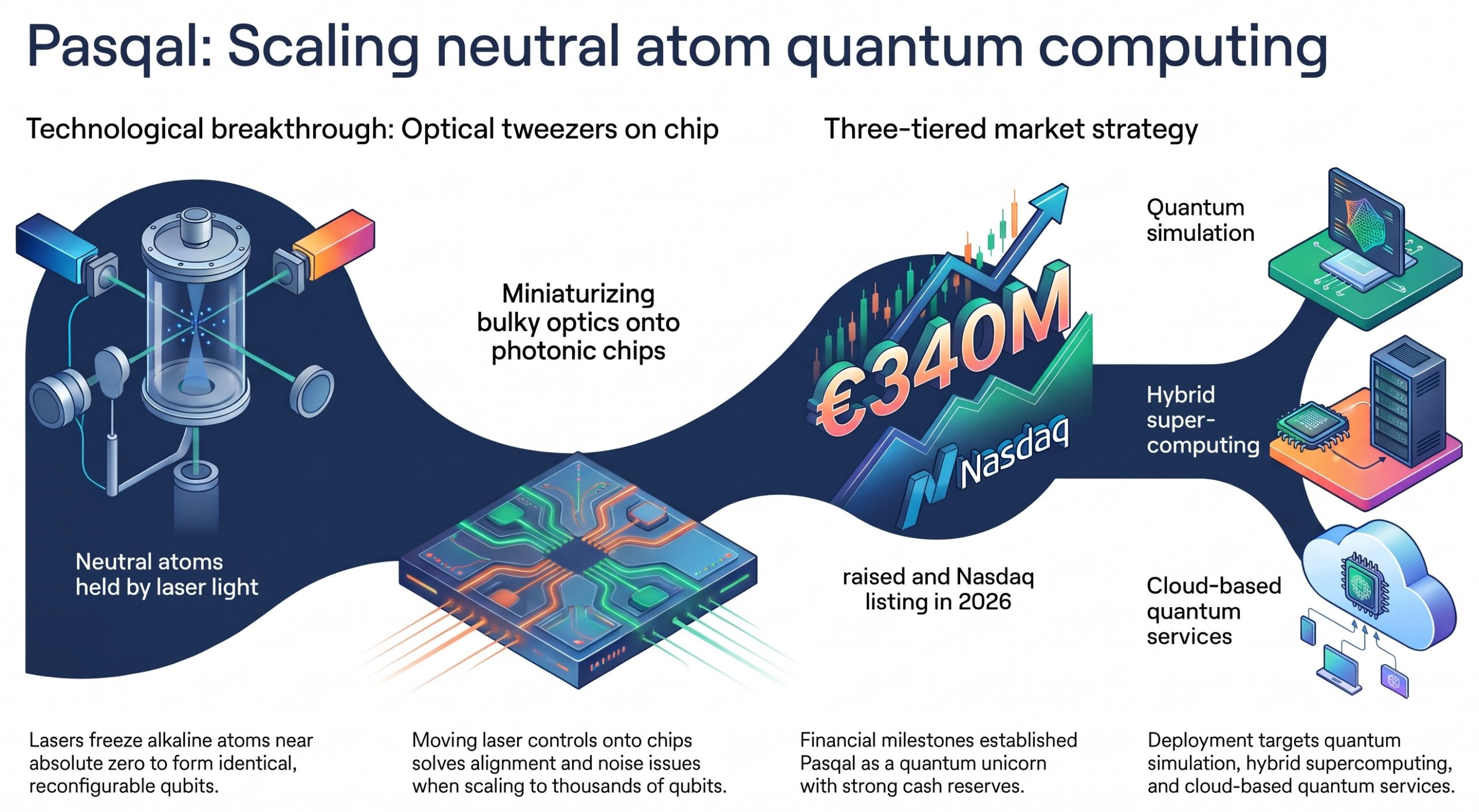
The principle is remarkably elegant. You take atoms — typically alkaline ones — and cool them to a few microkelvins, just above absolute zero, mere millionths of a degree above the lowest temperature possible in the universe. At these extreme temperatures, atoms become almost motionless. You can then grab them individually with “optical tweezers”: finely focused laser beams that, through the pressure of light itself, hold each atom as if in an invisible nano-vise. Hundreds of atoms trapped this way are arranged in regular arrays, forming the computer’s qubits. To make these qubits interact and create entanglement — the quintessential quantum resource — the atoms are briefly excited into so-called “Rydberg” states, where their electron drifts so far from the nucleus that the atom becomes giant and extremely sensitive to its neighbors.
This approach has considerable advantages: neutral atoms are identical by nature (no manufacturing defects as with an electronic chip), they can be manipulated at room temperature inside a vacuum chamber, and the geometry of the qubit array is reconfigurable at will. This is what allowed Pasqal to deliver, as early as 2024 under the EuroHPC tender conducted with Eviden (formerly Atos), two 100-qubit quantum accelerators coupled to the supercomputers of the CEA near Paris and of the Jülich research center in Germany.
The Scaling Bottleneck
But the neutral-atom approach also has its Achilles’ heel — and it is precisely the one Pasqal is now attacking. Generating hundreds of optical tweezers today requires bulky “free-space” optics: lasers, spatial light modulators, systems of lenses and split beams, all aligned with micron-level precision on an optical table. This worked admirably for a hundred qubits. It becomes an engineering nightmare for thousands: every optical element adds drift, noise, bulk and cost. It is much like the difference between the earliest vacuum-tube computers that filled entire rooms and the integrated circuit that put everything on a single chip.
The move “on chip” announced by Pasqal transposes this lesson from the history of electronics into the quantum world: integrating the generation of optical traps into a photonic chip — a miniaturized, manufacturable component — rather than a table-top optical setup. The expected benefits match the stakes: drastically improved mechanical and thermal stability, the ability to multiply the number of tweezers — and therefore qubits — simply by moving to denser chips, industrial reproducibility, and lower manufacturing and maintenance costs. In short: the material precondition for the neutral-atom quantum computer to graduate from laboratory demonstration to datacenter-ready infrastructure.
It is worth pausing on the symbolic dimension of this fusion of two worlds: the chip, icon of classical microelectronics, becomes the host of individual atoms suspended in light. It is integrated atom optics — a branch of research explored in labs for years — that is here stepping through the door of industry.
A Blazing 2026
This announcement did not come out of nowhere: it crowns an exceptional year for the company. On March 4, 2026, Pasqal closed a €340 million funding round, pushing its valuation to roughly $2 billion and making it the first unicorn in quantum computing from continental Europe. On August 28, the company took a further step by listing on the New York Stock Exchange through a merger with investment firm Bleichroeder, which strengthened its cash position by $360 million.
This financial footing feeds a dense scientific roadmap, as the company’s recent announcements show. In late October, Pasqal revealed that its neutral-atom processor had uncovered quantum magnet behavior that theory did not predict — proof that these machines are no longer mere demonstrators but genuine instruments of discovery, able to probe the physics of strongly correlated matter beyond the reach of classical supercomputers. In early October, Pasqal launched an AI-assisted workflow to speed up experiment design on its cloud-accessible processors — one more bridge between the two defining technologies of our time. The company also leads the European Q-PLANET project dedicated to neutral-atom technologies, achieved ISO 27001 certification across its activities, and strengthened its leadership with the appointment of a Chief Legal Officer — all signs of a company structuring itself as an industrial player.
A Market in Full Strategic Ferment
The market Pasqal targets goes far beyond selling machines. It unfolds on three levels. First, quantum simulation: modeling new materials, chemical molecules, complex magnetic systems — problems where the neutral-atom approach excels and which matter to chemistry, pharma and materials science. Second, hybrid computing: coupling a quantum processor to a classical supercomputer, as with the EuroHPC accelerators near Paris and in Jülich, so that companies can test concrete use cases — logistics optimization, finance, energy — without rewriting their entire computing pipelines. Third, cloud access: Pasqal’s QPUs have been reachable over the Internet since 2022, a “quantum as a service” model that prefigures how the technology will be consumed in the future.
The geopolitical context strongly favors this sector. Quantum computing is among the sensitive technologies targeted by US restrictions on outbound investments toward China, alongside semiconductors and AI — a clear sign that the great powers treat it as a first-order strategic technology. In Europe, the new alliance sealed in late October 2026 between the European Union and Canada explicitly cites quantum among its cooperation areas for technological sovereignty. And the company itself has long enjoyed strong state support, from a national quantum plan to defense innovation funding.
The competition, meanwhile, is not standing still. On the superconducting side, Google demonstrated in late 2024 with its Willow chip error correction below the fault-tolerance threshold, and IBM is aiming at “quantum utility” by combining multiple chips. In neutral atoms, America’s QuEra and Germany’s planqc, a spin-off of the Max Planck Institute, are advancing on three-dimensional optical lattice architectures. Microsoft is exploring a bold but still-debated topological route. In this global race, the challenge is not merely to add qubits, but to produce thousands of usable, reliable ones that can be connected to classical computing. That is exactly what optical tweezers on chip promise.
The Scale That Will Decide Everything
One central unknown remains: the timeline. The history of quantum computing is paved with spectacular announcements followed by long marches toward industrial reality, and the challenges of error correction remain the common frontier of every qubit technology. But by choosing to attack the scaling problem through photonic integration — the very move that once triggered the silicon revolution — Pasqal is sending a clear message to its freshly won investors on the Nasdaq and to its European partners: the neutral-atom quantum computer is not a laboratory curiosity, it is a platform on its way to industry.
From the chip that revolutionized electronics to the chip that will hold light itself to trap atoms one by one, the loop has almost come full circle. The physics of photons that once earned a Nobel Prize is now hard at work inside the machine built to harness it.