


Why spend months designing a product, writing dozens of articles, and chasing your first users when you can simply buy a business that already generates cash flow?
In the digital M&A (Mergers & Acquisitions) ecosystem, acquiring a website or a SaaS has become the modern equivalent of commercial real estate investment. By purchasing an existing asset, you are not just buying lines of code or a design: you are acquiring established SEO authority, a history of qualified traffic, and a proven conversion engine. It is the ultimate shortcut to skip the startup phase, which is inherently risky and time-consuming.
However, the digital asset acquisition market does not forgive amateurism. Between the information asymmetry between sellers and buyers, valuations totally disconnected from the market, and increasingly sophisticated audience falsification techniques (fake traffic), a poorly audited deal can quickly turn into a financial sinkhole.
Whether you are an entrepreneur looking for external growth, an investor seeking returns, or a web professional wanting to launch your next side-project, you must approach this process with the rigor of an investment fund. Here is the step-by-step method to buy a website while minimizing your risk.
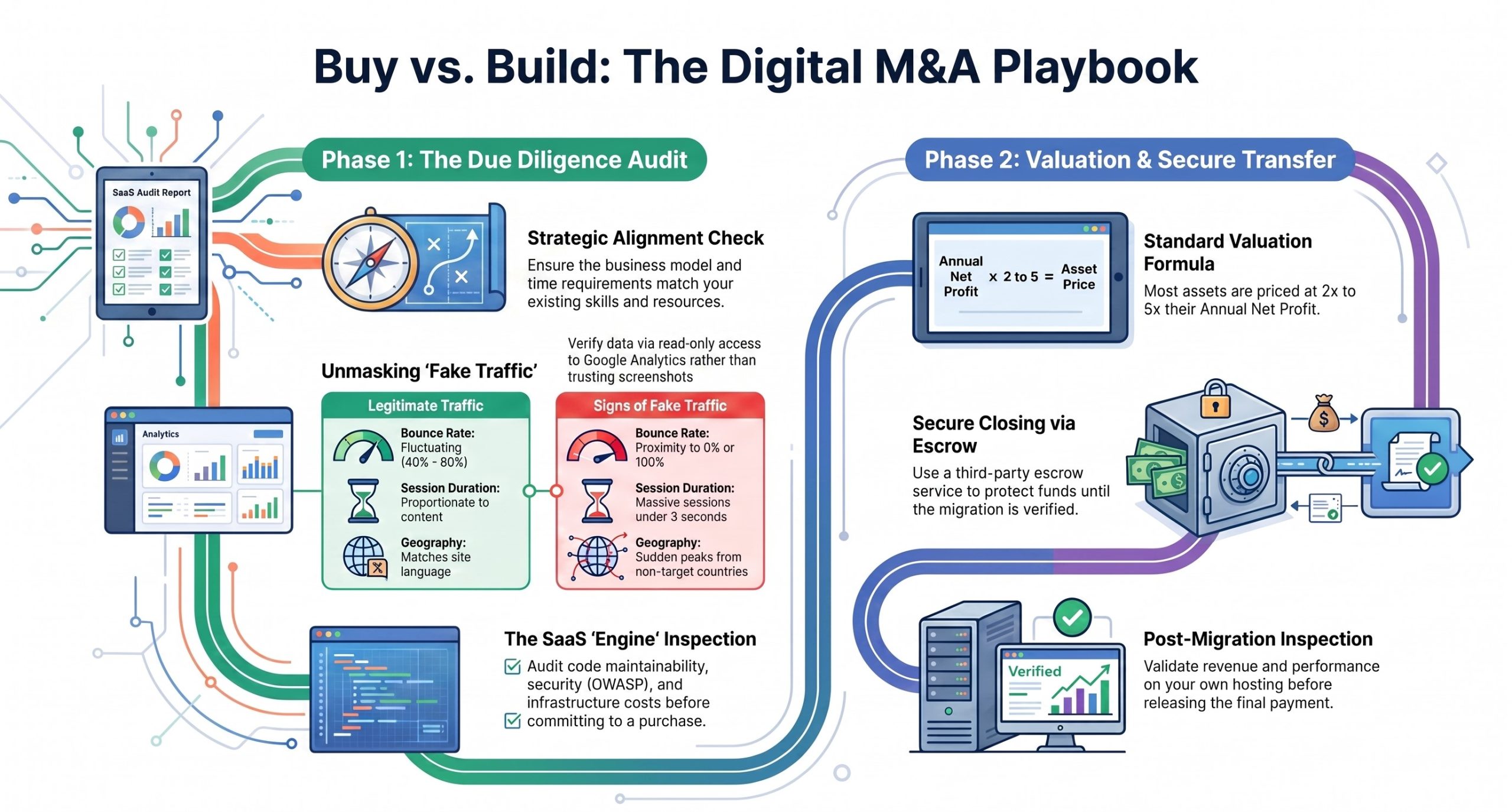
1. Validate alignment with your target activity
Before diving into balance sheets, you must validate the site’s strategic alignment with your skills, resources, and long-term goals.
- The monetization model: Is it affiliation, e-commerce (WooCommerce/Shopify), a SaaS, or the sale of info-products? You must master the codes of the chosen model or be ready to delegate.
- The required management time: An SEO-optimized content site often requires less daily maintenance than an e-commerce store (which involves customer support and inventory management) or a SaaS (which requires technical support).
- Synergy vs. Skills: Does the site complement an existing activity (to acquire new customers at a lower cost or expand a product catalog) or does it require technical skills you do not yet possess?
2. The technical audit: Analyze the audience and unmask “Fake Traffic”
Never trust the screenshots provided in a sales pitch. A savvy buyer demands direct read-only access to Google Analytics (or Plausible) as well as the Google Search Console.
The essential SEO metrics to verify
- The historical traffic trend: Is the traffic stable, growing organically, or in structural decline following a recent Google algorithm update?
- Keyword distribution: Does the site rely on one or two main keywords (which represents a major risk if you lose these positions) or is it positioned on a diversified long tail?
- The backlink profile: Are the links pointing to the site natural, themed, and of high quality, or do they come from spam networks (low-quality PBNs) artificially built to inflate the site’s authority before the sale?
How to identify Fake Traffic?
Traffic bought or generated by bots is the number one trap during a digital acquisition. Here is how to visually tell the difference during your audit:
| Indicator | Legitimate Traffic | Signs of Fake Traffic |
| Acquisition sources | Balanced mix of SEO, direct, social, and referral | 99% “Direct” traffic or coming from obscure referring sites |
| Bounce rate | Fluctuating according to page types (40% to 80%) | Close to 0% or exactly 100% (typical bot behavior) |
| Session duration | Proportional to the actual length of the content | Massive sessions of less than 3 seconds |
| Geography | Perfectly consistent with the site’s language | Sudden spike in traffic from a country not targeted by the offer |
3. SaaS Focus: Auditing technical debt and source code
Buying a SaaS without auditing its code is like buying a factory without checking the condition of the machines: if the engine is obsolete or poorly designed, your profitability will collapse at the first bug or the first attempt to scale (scaling). You must analyze 5 surgical criteria:
- Stack Obsolescence and Maintainability: Are the versions of frameworks and languages (Node.js, Python, PHP, Laravel, React…) still actively supported? A project relying on dozens of third-party libraries abandoned for years is a ticking time bomb. Also, ensure that a new developer can clone the repository and launch the local environment in less than an hour (via Docker).
- Code architecture and test coverage: Does the code meet market standards (MVC, Clean Architecture)? Demand a coverage report. A serious SaaS should display at least 60% to 80% coverage by unit and integration tests. Without tests, every new update risks breaking existing features.
- Infrastructure costs and third-party APIs: Analyze the history of hosting bills (AWS, Google Cloud, Vercel). Does the bill increase linearly or exponentially with the number of users? If the SaaS integrates LLMs (OpenAI, Anthropic), verify that the code uses caching systems to avoid paying multiple times for the same requests.
- Security and data isolation: Sift the source code through security scanning tools (Snyk, SonarQube) to detect the OWASP top 10 vulnerabilities. The architecture must tightly guarantee that user A can never access the data of user B (Multi-tenancy).
- Database performance: Does the database correctly use indexes? Is there a profusion of slow queries (heavy queries that take more than a few milliseconds to execute) that will accumulate as the user table grows?
4. Determine the right price: Valuation of the site or SaaS
The price of a website is not guessed; it is calculated based on its historical financial performance and its recurrence.
The basic formula generally relies on a multiple of the annual net profit (or EBITDA for larger structures):
The multiple generally varies between 2 times and 5 times (sometimes more for SaaS benefiting from strong MRR revenue recurrence) depending on the stability of the project, the attrition rate (churn), customer retention, and dependence on the founder.
💡 To go further: The financial evaluation of a digital asset depends on several subtle variables (history, sector trends, audience typology). To avoid overvaluing an asset, consult Lunil’s detailed guide on the 7 essential criteria for estimating a website’s value.
5. The step-by-step acquisition process
Buying a digital asset follows a strict protocol to ensure the security of both parties. Never skip steps.
- Due Diligence (In-depth audit): Ask for live screen shares of payment processors (Stripe, PayPal) and affiliate accounts to cross-reference the actual figures with the accounting provided by the seller.
- Negotiation and Letter of Intent (LOI): Put the terms of the agreement in writing: the final price, transition conditions (support period by the seller), and the precise transfer schedule.
- Securing funds via a trusted third party: This is the crucial step against fraud. Never transfer money directly to the seller’s bank account before the transfer. Use an Escrow system or go through a secure platform.
- The technical migration: Proceed with the transfer of ownership of all assets: domain name, site files, databases, social media accounts, registered trademarks, and source code.
- Inspection period and release of funds: As a buyer, you have a few days to verify that the site works correctly on your own hosting and that the generated revenue matches the promises before the trusted third party releases the funds to the seller.
6. Classic pitfalls to avoid
- Dependence on the founder: If the site only runs because the seller spends 40 hours a week on it or because it relies entirely on their personal brand (personal branding), the value of the asset risks collapsing immediately after the sale.
- Hidden technical debt: Poorly documented SaaS code, an obsolete WordPress theme that is no longer updated, or premium extensions whose licenses are not included and which will block future versions of the site.
- Plagiarism and content theft: Use tools like Copyscape to check that the site’s content is not a simple copy of other platforms, which would expose the site to a major short-term SEO penalty.
Take action safely
Buying a website or a SaaS is an excellent growth lever, provided you show mathematical and technical rigor during the audit.
To simplify your steps, centralize your research, and move forward with peace of mind, you can browse the opportunities available on the Lunil Marketplace. Designed to secure end-to-end transactions, the platform integrates a buyer protection option backed by a robust escrow system. Your funds are kept safe and are only paid to the seller once you have fully validated the technical migration and the asset’s compliance.