

The market for software asset acquisitions is no longer limited to B2B SaaS giants or high-volume e-commerce platforms. Every year, thousands of independent developers, mobile studios, and side-project creators sell their iOS and Android apps to buyers, investors, or app aggregators. However, selling a mobile app involves technical, regulatory, and financial constraints that differ significantly from those of traditional web businesses.
From managing store credentials (App Store Connect, Google Play Console) and ensuring the continuity of recurring in-app subscriptions to separating cloud infrastructure and securing transaction funds, selling a mobile app requires a rigorous and methodical approach.
This comprehensive guide examines every stage of the sales process: from estimating the value of your project to the final technical handover, including the strategic use of an escrow account.
1. How to Value a Mobile App
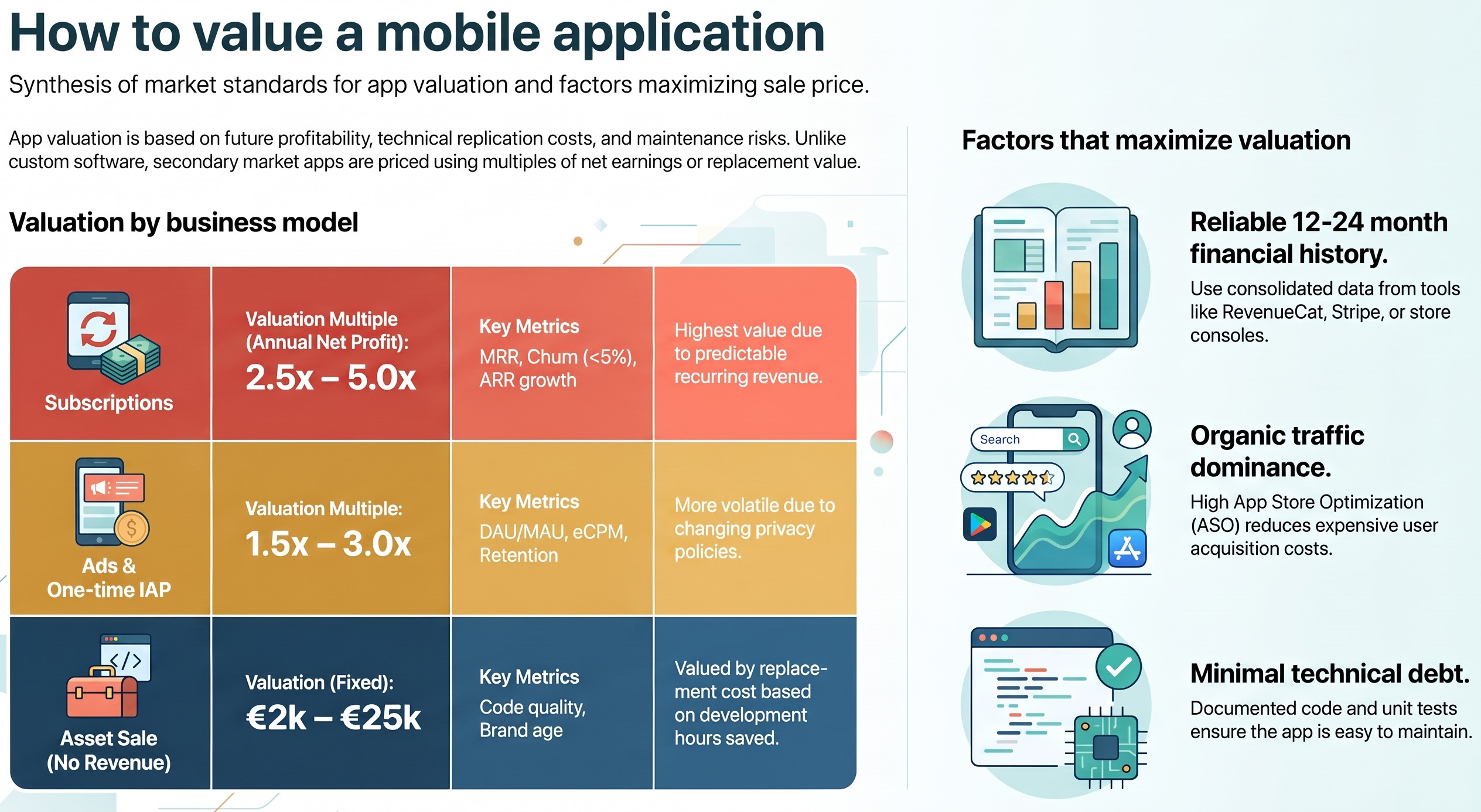
Estimating the market value of an app is not something that should be done arbitrarily. Unlike a custom software product commissioned by a client, an app sold on the secondary market is valued based on its future profitability potential, its technical replication cost, and the risks associated with its maintenance.
A. Business Models and Valuation Multiples
The most widely used valuation method involves applying a multiple to annual net earnings (generally calculated using SDE, or Seller’s Discretionary Earnings, for independent businesses, or EBITDA for established studios).
- Recurring In-App Subscriptions:
- Model: This is the model most sought after by buyers because of its predictability.
- Key metrics: Monthly Recurring Revenue (MRR), Annual Recurring Revenue (ARR), monthly churn rate, Lifetime Value (LTV), and Customer Acquisition Cost (CAC).
- Observed multiples: Between 2.5x and 5x annual net earnings (or 1.5x to 3x ARR for fast-growing apps). A monthly churn rate below 5% and consistent year-over-year growth of at least 20% can push valuations toward the upper end of this range.
- In-App Advertising & One-Time In-App Purchases (AdMob, Consumable IAPs):
- Model: Common in mobile games (casual gaming) and utility apps with large audiences.
- Key metrics: Daily Active Users (DAU), Monthly Active Users (MAU), eCPM (effective cost per thousand impressions), and retention rates on Day 1, Day 7, and Day 30.
- Observed multiples: Between 1.5x and 3x annual net profit. The volatility of advertising algorithms and dependence on updates to privacy policies (such as Apple’s ATT framework) generally lead buyers to apply more conservative multiples.
- Apps Without Revenue (Asset Sale):
- Model: The project has not yet monetized its audience, or it is a functional MVP.
- Valuation method: Replacement cost. The buyer assesses the number of development hours saved by acquiring the project, including the time required to build a similar architecture, test compliance with app store requirements, and obtain the first reviews and downloads. Valuations generally range from €2,000 to €25,000, depending on the brand’s age and code quality.
B. Factors That Maximize Your Valuation
To negotiate toward the upper end of the valuation multiples, your documentation should demonstrate:
- Verifiable financial history: Consolidated data covering at least 12 to 24 months, obtained through established analytics tools such as RevenueCat, Adapty, Stripe, or directly from the Apple and Google consoles.
- Diversified traffic sources: A substantial share of organic traffic (ASO – App Store Optimization) reduces the need for paid user acquisition (UA) spending.
- Minimal technical debt: Well-documented code, unit and integration tests, stable SDK versions (avoid obsolete frameworks), and compliance with the latest Apple and Google guidelines.
2. The Transaction Process: From Listing to Closing
Selling your app requires a structured framework to avoid wasting time and to protect your intellectual property.
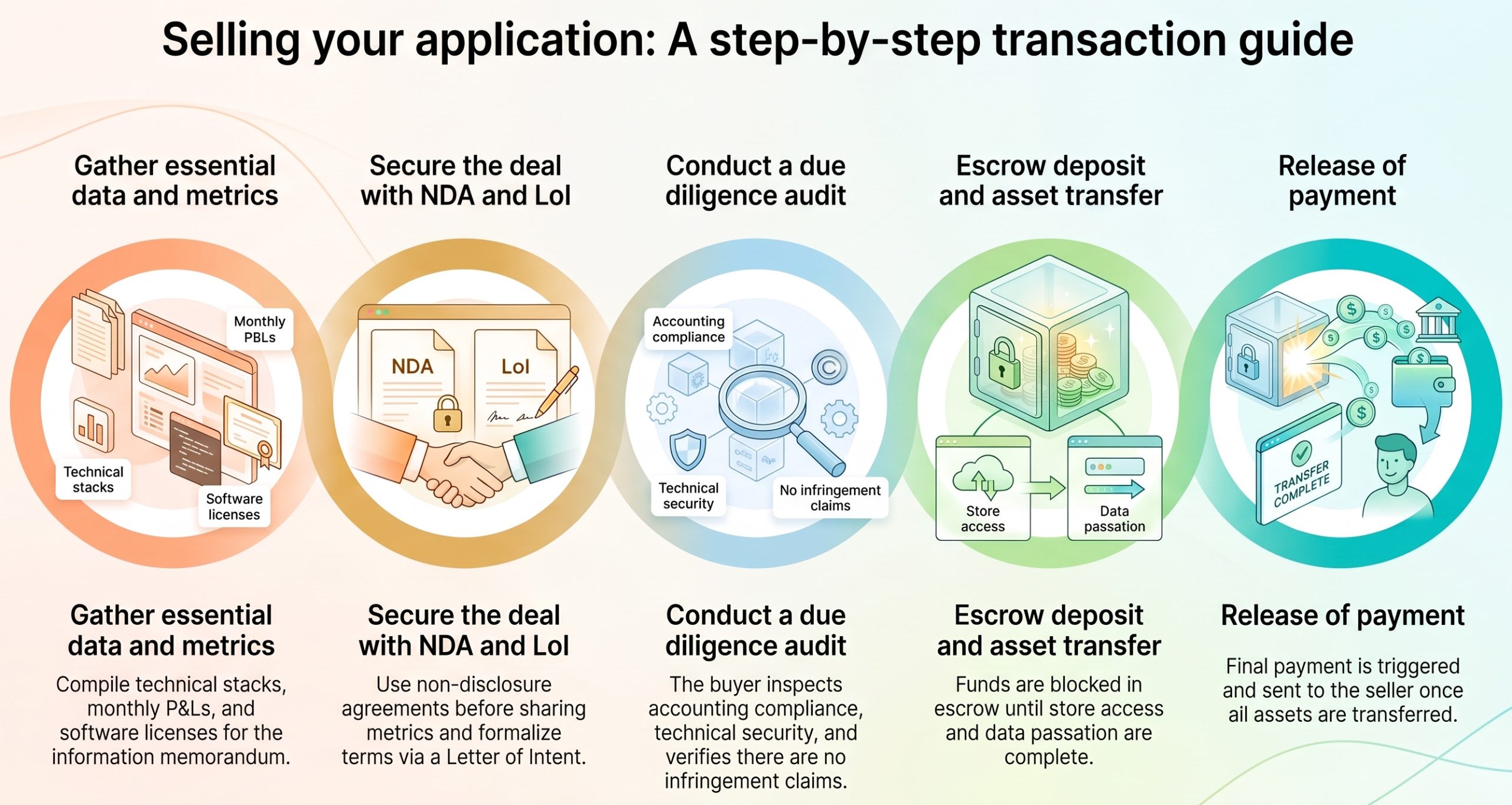
+------------------+      +-------------------+      +--------------------+
|  1. Preparation  | ---> |  2. Negotiation   | ---> | 3. Escrow Deposit  |
| Metrics & Code   |      | Offer & LoI/NDA   |      | Funds Secured      |
+------------------+      +-------------------+      +--------------------+
                                                               |
+------------------+      +-------------------+                |
| 5. Fund Release  | <--- | 4. Handover       | <--------------+
| Seller Payment   |      | Stores & Data     |
+------------------+      +-------------------+
Step 1: Prepare the Information Memorandum
Gather all the essential information: technology stack, usage metrics, monthly income statements, contracts with any service providers, and software licenses.
Step 2: Sign a Non-Disclosure Agreement (NDA) and Letter of Intent (LoI)
Before granting read-only access to your detailed metrics or a portion of your architecture documentation, have the buyer sign a non-disclosure agreement. Once the price and scope have been agreed upon, formalize the agreement with a Letter of Intent (LoI), which records the agreed terms and defines the due diligence period.
Step 3: Due Diligence Audit
The buyer examines the company’s accounting and technical compliance. They check for any infringement claims, analyze cohort retention, and audit the app’s security.
3. Securing the Transaction with an Escrow Account: Why It Is Essential
In an online digital asset transaction, the lack of mutual trust is a major risk factor:
- The seller is concerned about transferring the app on the stores and handing over code repositories without a guarantee of payment.
- The buyer is concerned about paying the funds and receiving an unusable codebase, a non-compliant store account, or discovering that the seller has retained hidden access.
How the Independent Escrow Mechanism Works
Using an escrow service (such as the one offered by Lunil in partnership with licensed payment institutions) helps mitigate these risks:
- Irrevocable deposit of funds: The buyer deposits the full purchase price into a dedicated, segregated escrow account. The funds are verified and held by the financial intermediary.
- Seller notification: The seller receives formal confirmation that the funds are secured and available.
- Execution of technical transfers: The seller transfers ownership of the app on the App Store, Google Play, and GitHub, along with the databases and third-party services.
- Inspection period: The buyer has a predefined period (generally 3 to 5 business days) to test a local build of the code, verify administrator rights in the store consoles, and confirm receipt of the metrics.
- Fund release and payment: Once compliance has been confirmed (or when the inspection period expires without a substantiated objection), the escrow service promptly releases the funds to the seller.
4. Operational Technical Checklist for the Transfer
To ensure a seamless transition for users and prevent data leaks, carefully follow this technical roadmap.
A. Architecture Separation & Security
- Git history cleanup: Check that no passwords, Stripe tokens, private certificate keys, or Firebase credentials have been stored in historical commits. Use tools such as
git-filter-repoto permanently purge the history if necessary. - Environment variable preparation: Provide a comprehensive
.env.examplefile listing every required dependency and explaining the purpose of each secret. - Open-source license review: Make sure that imported packages (through CocoaPods, SPM, Gradle, or npm) do not violate commercial-use rules and contain no problematic dependencies that could prevent the transfer.
B. App Store Connect Transfer Procedure (iOS)
Apple allows individual apps to be transferred between developer accounts without service interruption.
- Apple’s prerequisites:
- No app version must be undergoing review (In Review).
- No active TestFlight testing using a public group must be in progress (remove external testers).
- In-App Subscriptions must be configured without relying on a non-transferable shared identifier.
- Information to obtain from the buyer:
- The email address associated with their administrator Apple ID.
- Their Team ID, available in their Apple Developer account.
- Execution: Go to App Store Connect > General > App Information, then click the Transfer App link at the bottom of the page. Once the buyer accepts the operation in their own console, the transfer takes effect without interrupting service for existing subscribers.
C. Google Play Console Transfer Procedure (Android)
Google also allows apps to be transferred smoothly between developer accounts.
- Information to obtain from the buyer:
- The official name of the destination developer account.
- The email address associated with the target account.
- The transaction ID for the destination Google Play developer account registration (found on the receipt for the $25 registration fee).
- Signing key management:
- If Google Play App Signing is enabled: the transfer is straightforward because Google holds the app signing key used for distribution.
- For legacy manual signing: you must export and provide the keystore file (
keystore/.jks), the keystore password, the alias, and the alias password. Without these items, the buyer will be unable to publish updates.
- Execution: Submit the request using the dedicated Google Play Console form. Google’s teams generally process the request within 24 to 48 business hours.
D. Backend Infrastructure, Data & Monetization Services
- Database and servers: If the infrastructure relies on a PaaS (Supabase, Firebase, AWS, Railway), prioritize transferring ownership of the cloud organization or project directly. Otherwise, provide a complete SQL export (
pg_dumpor equivalent), an export of storage buckets (S3), and restoration scripts. - Monetization platforms (RevenueCat, Adapty): These platforms allow you to invite the buyer as the project owner. Remember to update API credentials and webhook configurations on the backend and in the Apple and Google consoles.
- Advertising networks: The buyer must integrate their own AdMob/Unity Ads credentials into a new app update and publish the
app-ads.txtfile on the domain associated with the project. - Domain names: Transfer the domains associated with APIs and landing pages by providing the transfer authorization code (Auth-Code). Reduce the TTL to 300 seconds a few days before migration to enable DNS traffic to switch over quickly.
5. Comparison of Solutions for Selling Your Mobile App
When a developer decides to sell their work, three main options are available:
| Evaluation Criteria | General Marketplaces (e.g., US platforms) | Private Sale (Forums, X, LinkedIn) | Lunil |
| Listing Fees | Often paid (from $50 to $250) | €0 | €0 (100% free) |
| Transaction Fees | 10% to 15% of the sale price | 0% | No hidden commissions |
| Payment Security | Sometimes included, but subject to high currency conversion fees | None (direct bank transfer without a guarantee) | Secure escrow option available |
| Mobile Technical Expertise | Limited (focused on content websites and e-commerce) | Variable, with a risk of dealing with inexperienced buyers | Dedicated to software and mobile projects |
| Confidentiality | Metrics may sometimes be publicly exposed | Limited contractual protection | Introductions under an NDA available |
6. Frequently Asked Questions (FAQ)
What legal status do you need to sell a mobile app?
You can sell your app whether you are a sole proprietor, a company (SASU, SAS, SARL), or a private individual. If you sell as a private individual, the transaction may involve the transfer of copyright or intangible movable property. The applicable tax treatment depends on your country of tax residence. In France, capital gains from the sale of intangible assets may be subject to the flat tax (a 30% single flat-rate tax) or the progressive income tax scale. Always consult a chartered accountant or tax specialist before completing the transaction.
What happens to active subscribers when an iOS app is transferred?
When an app is transferred through App Store Connect, existing auto-renewable subscriptions continue without interruption. Apple continues charging end users and pays the net proceeds into the bank account configured by the new owner once the transfer is complete. The buyer does not need to force users to re-enter their payment details.
Can the buyer refuse to release the escrow funds?
The buyer cannot arbitrarily refuse to release the funds. The escrow agreement states that a refusal must be based on a proven failure to comply with the terms of the original agreement (for example, the source code does not compile, the financial metrics provided were falsified, or access to the stores was not granted). If a disagreement persists, an independent arbitration procedure can be used to determine the rightful recipient of the funds.
How long does it generally take to sell an app?
The average time required to sell a mobile app ranges from 2 to 8 weeks. Projects generating between €500 and €5,000 in MRR and featuring a clear architecture are often negotiated more quickly because they match the acquisition profiles of many individual buyers and micro-investment funds.
Summary: Successfully Selling Your Mobile Project
Selling a mobile app is a major milestone for a developer. By carefully preparing your financial documentation, cleaning up your software architecture, and securing the transaction through a reliable escrow solution, you can maximize your project’s valuation while eliminating the risk of non-payment.
List your app for sale today on Lunil to showcase your project to a network of qualified buyers, with no listing fees and complete confidentiality.








The 1.5x to 3x range for ad-based apps feels right. Since ATT rolled out, my eCPM dropped 40% and buyers noticed immediately.
Great breakdown of the escrow process. I sold a habit tracker last year for $4,500 and the inspection period was the most stressful part by far.
I had no idea an app with zero revenue could still sell for €2,000 to €25,000 based on replacement cost. That changes my whole exit plan.
L’ATT framework a vraiment cassé les valorisations des apps pub. J’ai vu des multiples tomber de 3x à 1,5x en un an.
The technical debt point cannot be overstated. I spent €4,000 fixing obsolete SDKs just so my app would pass due diligence.
Honestly, I would never transfer App Store Connect access without escrow. Too many horror stories of sellers ghosting after the handover.
This guide is bookmarked. I’m 6 months away from listing my fitness app and the documentation checklist alone saved me hours of research.
On Android, don’t forget Google Play Console now requires two-step verification on the new owner’s account before you can transfer. Slowed my deal by a week.
The 2.5x to 5x multiple on subscriptions seems optimistic. Most buyers I’ve talked to won’t go above 3x unless churn is under 3%.
The LoI stage is where I messed up last time. I gave read-only access to my analytics too early and the buyer just used it to benchmark and ghosted me.
Anyone have experience transferring a Flutter app? Wondering if the open-source license review is more complex with all those pub packages.