


In the constant pursuit of yield and inflation protection, traditional financial analysis has historically prioritized equities, corporate or sovereign debt, and real estate. However, as the tech ecosystem has matured, a new alternative asset class has firmly established itself, drawing strong interest from private investors, family offices, and private equity funds: established online businesses.
What was considered an informal or highly speculative sector just a decade ago has evolved into a structured secondary market. The acquisition and sale of digital assets—such as specialized content portals, e-commerce platforms, mobile applications, and Software-as-a-Service (SaaS) models—now offers an investment alternative featuring predictable cash flows, attractive yields, and low correlation with traditional stock markets.
Beyond traditional websites, many investors are now learning how to buy a YouTube channel with subscribers to instantly tap into established video audiences.
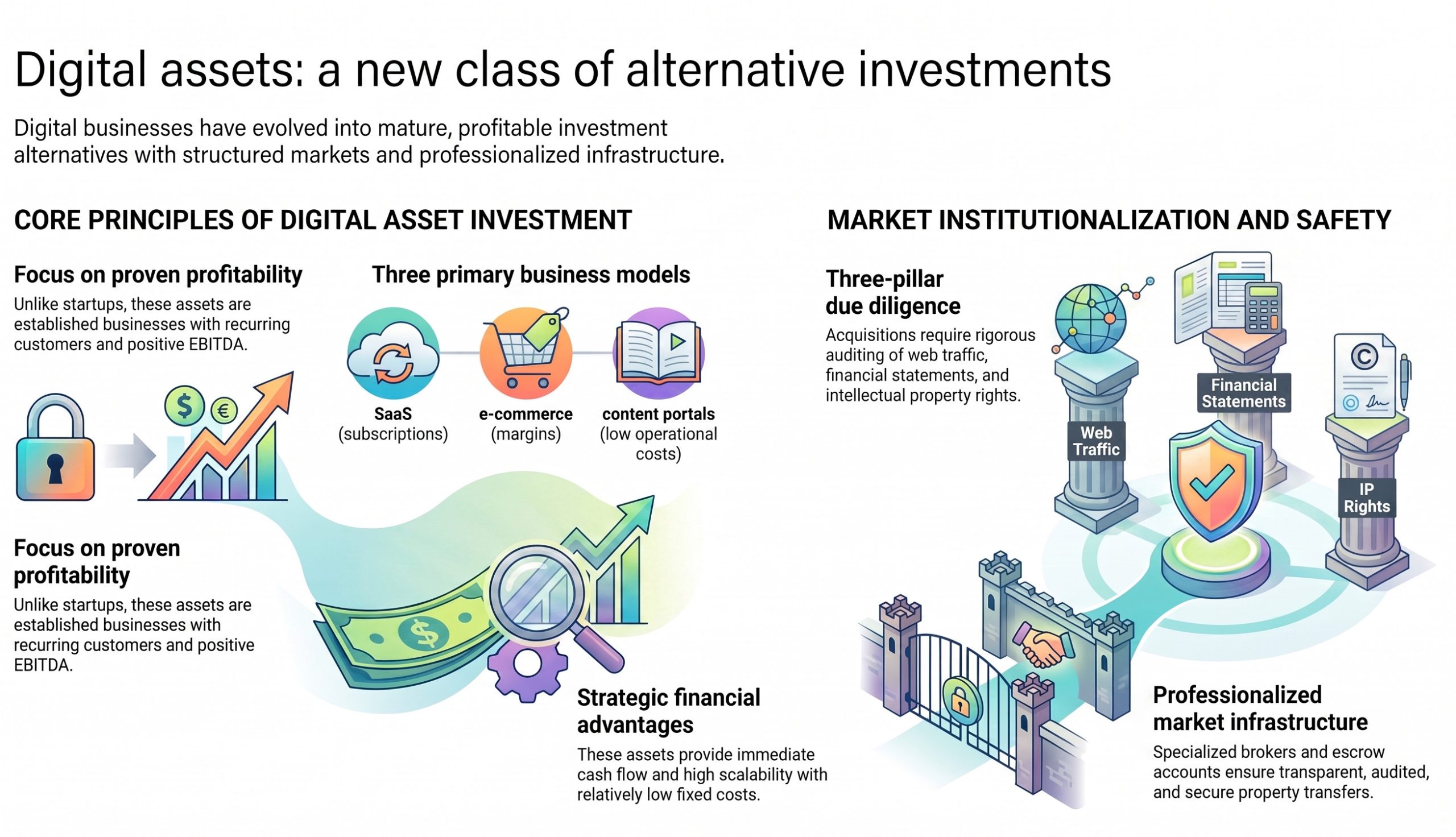
1. The Rise of Digital Assets as an Alternative Asset Class
Including online businesses in investment portfolios stems from a clear financial dynamic: the search for risk-adjusted returns in an environment where traditional assets face high valuations or compressed margins. An established digital asset operates with a relatively low fixed-cost structure and a capacity for scalability rarely found in brick-and-mortar commerce.
Unlike early-stage ventures or venture capital investments—where high mortality rates are accepted in exchange for the promise of exponential growth—the secondary digital market targets profitable businesses with a proven track record. These are business units that have already passed the validation stage, possess a recurring customer base, and consistently generate positive EBITDA.
Key advantages that financial analysts identify when evaluating this asset class include:
-
Immediate Cash Flow Generation: By acquiring an operating business, the investor receives cash flows from day one, skipping the initial capital-burn phase.
-
Operational and Geographic Flexibility: The remote nature of these assets allows management from any location, facilitating the international diversification of capital.
-
Revenue Stream Diversification: Acquiring multiple small or mid-sized projects across independent market niches reduces exposure to sector-specific shocks.
2. Business Models in the Secondary Market and Their Yield Profiles
Within the digital asset spectrum, risk and return profiles vary significantly depending on the underlying monetization model. To structure a portfolio effectively, investment managers must distinguish the operational dynamics of each segment:
A. Software-as-a-Service (SaaS)
SaaS assets command the highest valuation multiples due to their highly predictable revenue streams. Built on recurring subscription models (monthly or annual), a SaaS company’s value lies in code stability, low marginal retention costs, and a critical core metric: Customer Lifetime Value (LTV) relative to Customer Acquisition Cost (CAC).
B. E-Commerce and Marketplaces
This category encompasses both proprietary online stores and brands operated on established third-party platforms. Although they require inventory and supply chain management, their valuation relies on gross margins, repeat purchase rates, and brand equity.
C. Content Assets and Digital Media
This includes niche blogs, news portals, and thematic channels monetized through display advertising, affiliate marketing, or brand sponsorships. They carry minimal operational costs and high net profit margins, though they depend heavily on organic traffic stability and domain authority.
3. Market Institutionalization: Transparency, Valuation, and Liquidity
A primary historical barrier to institutional capital entering the website M&A space was the lack of liquidity and standardized valuation and due diligence processes. Informal, direct transactions between individuals introduced significant information asymmetries along with financial and technical risks.
The professionalization of the sector has been driven by specialized brokerage platforms and secondary marketplaces. These entities act as neutral intermediaries responsible for auditing organic traffic, verifying financial records via payment gateway integrations, and holding funds in escrow until the transfer of technical ownership is completed.
Within this framework of operational transparency, platforms in the sector such as Lunil provide the infrastructure for the secure trading of digital assets, allowing investors to access catalogs of online businesses with audited financial metrics and verified revenue models. This structure substantially mitigates counterparty risk while supplying the liquidity necessary for the secondary market to function efficiently.
4. Risk Management and Due Diligence in Online Business Acquisitions
Investing in digital assets demands a rigorous risk management framework combining traditional financial analysis with technical IT auditing. A thorough evaluation should address three primary areas:
Traffic and Analytics Auditing
Analyzing traffic sources over an extended time horizon (at least 12 to 24 months) is essential. Investors must verify that traffic is genuine, not overly reliant on unprofitable paid advertising, and sufficiently diversified to withstand potential search engine algorithm updates.
Financial and Revenue Verification
Cross-referencing web analytics with bank statements and payment processor accounts (such as Stripe or PayPal) is mandatory. Analysts must calculate adjusted EBITDA by stripping out non-recurring or personal expenses incurred by the seller to determine the true ongoing profitability.
Legal and Intellectual Property Audit
Confirming the ownership of domain names, source code, trademarks, and compliance with data privacy regulations (such as GDPR) ensures legal certainty during the transfer of ownership.
The consolidation of secondary digital markets represents a key milestone in corporate finance and wealth management. Online businesses have transitioned from simple creative projects into a mature asset class capable of delivering recurring income and true diversification within a balanced portfolio.
As transparency, legal security, and standardized valuation metrics continue to advance, acquiring digital assets is cementing its place as a strategic avenue for investors and funds seeking exposure to the digital economy with prudence, liquidity, and yield.








Alguém aqui já comprou canal no YouTube? Tenho curiosidade sobre como avaliam métricas de retenção versus número de inscritos.
Adjusted EBITDA is the key phrase here. Always strip out the seller’s personal expenses or you’ll overpay by 20% or more.
Bought a niche blog two years ago for $18,000. It now nets $1,200 monthly. Numbers like that are hard to find in index funds.
Der Punkt zur Rechtsprüfung wird oft vernachlässigt. GDPR-Verstöße können bei einem Kauf richtig teuer werden, gerade bei Content-Archiven.
Correlation with stocks is low until a Google update wipes out traffic. That’s not market risk, that’s platform risk in disguise.
Des cash-flows dès le jour 1, c’est l’argument qui m’a convaincu. Fini l’attente interminable du venture capital.
How do you handle seller financing? I’ve seen 12-month earnouts become standard in web deals, but buyers here rarely mention it.
Solid overview of the space. Quick question: what multiple range is realistic for a small content site right now, roughly 30x monthly profit?
The due diligence point is underrated. I passed on a deal last year because 70% of traffic came from one paid channel. Turned out to be the right call.