


Building an online store from scratch takes time: development, content, acquisition, SEO, tool configuration. Conversely, buying an e-commerce site allows faster access to an already established structure, often within 3 to 6 months, with an operational business and initial revenue right from the takeover.
The immediate benefits of buying an existing e-commerce site
Buying an e-commerce site is not limited to a domain name or a catalog. It is most often a complete digital business asset: brand, customer base, processes, sales history, and contracts already negotiated with suppliers or service providers.
In this context, buying a site that is already indexed also allows you to recover an existing SEO foundation: content, backlinks, positioned pages, and trust signals. As soon as the transition is well-prepared, the buyer has useful data to manage the takeover: traffic, conversion rates, average order value, and margin levels.
Taking over a site to access an already launched business
An existing e-commerce site offered on a reputable marketplace typically comes with a sales history of at least 12 months. This significantly reduces uncertainty at the time of investment. The buyer acquires an active customer base, already identified partners, and a sales mechanism that works.
- Transactional history: 12 months of monthly turnover to assess real performance.
- SEO already in place: organic positioning, content, and backlinks transferred with the site.
- Operational infrastructure: hosting, payments, and supplier connections already configured.
Which e-commerce site profiles for sale can you target?
The market for e-commerce sites for sale is broad. It includes dropshipping models, stores with inventory, niche brands, and more generalist players. A specialized e-commerce site can target, for example, pets, jewelry, or wine, with a clearer positioning and often more straightforward acquisition.
Each e-commerce for sale presents a different balance between risk, operational workload, and profitability. A dropshipping model eases logistics, with supplier lead times of 3 to 5 days, while a site with inventory often allows better management of the margin. In practice, taking over a relevant site primarily depends on available resources, mobilizable skills, and the level of involvement expected after the acquisition.
To buy an e-commerce site under good conditions, every listing deserves a structured review: legal setup, revenue streams, dependency on acquisition channels, and the quality of contracts.
Valuation analysis to buy a profitable website
Determining the right price for an e-commerce site requires a clear method. The value displayed by the seller and the one supported by the numbers do not always match: to buy a site or buy a website under good conditions, financial analysis remains the starting point.
Methods for calculating the price of an e-commerce site
In practice: a profitable site is often valued between 24 and 48 times the net monthly profit, which is roughly 1.5 to 2 years of adjusted profit. For a structured company, the French market also reasons between 2 and 5 times the annual adjusted EBITDA (EBE).
- Monthly profit multiple: from 24x to 48x the net monthly profit, depending on revenue stability, the niche, and the predictability of the business.
- Annual EBITDA multiple: from 2x to 5x the adjusted earnings for corporate structures.
- Market range: from €800 to €10,000 for small structures sold on marketplaces, up to several hundred thousand euros for more mature assets.
- Split payment: some platforms offer payment in 4 installments via PayPal, reducing the barrier to entry without changing the negotiation logic.
Before signing, have the adjustments validated by a certified accountant.
| Net monthly profit | Low valuation (24x) | High valuation (48x) |
| €500 | €12,000 | €24,000 |
| €1,000 | €24,000 | €48,000 |
| €2,000 | €48,000 | €96,000 |
| €3,000 | €72,000 | €144,000 |
Criteria that cause a site’s value to vary
Once this step is cleared, the price of an e-commerce site does not depend solely on profit. The niche, the diversification of acquisition channels, the quality of organic search engine optimization, and the dependency on paid advertising directly affect the final value during negotiation.
Conversely, two sites with comparable revenue will not sell at the same level if their operational risk differs. An e-commerce business that gets 70% of its traffic from organic SEO will generally be valued higher than an equivalent asset that is too dependent on Google Ads.
Where to find an e-commerce site for sale in France
The options for finding an e-commerce site to take over have expanded significantly. Not every channel offers the same level of transparency, support, or security to buy an e-commerce site or, more broadly, buy a site.
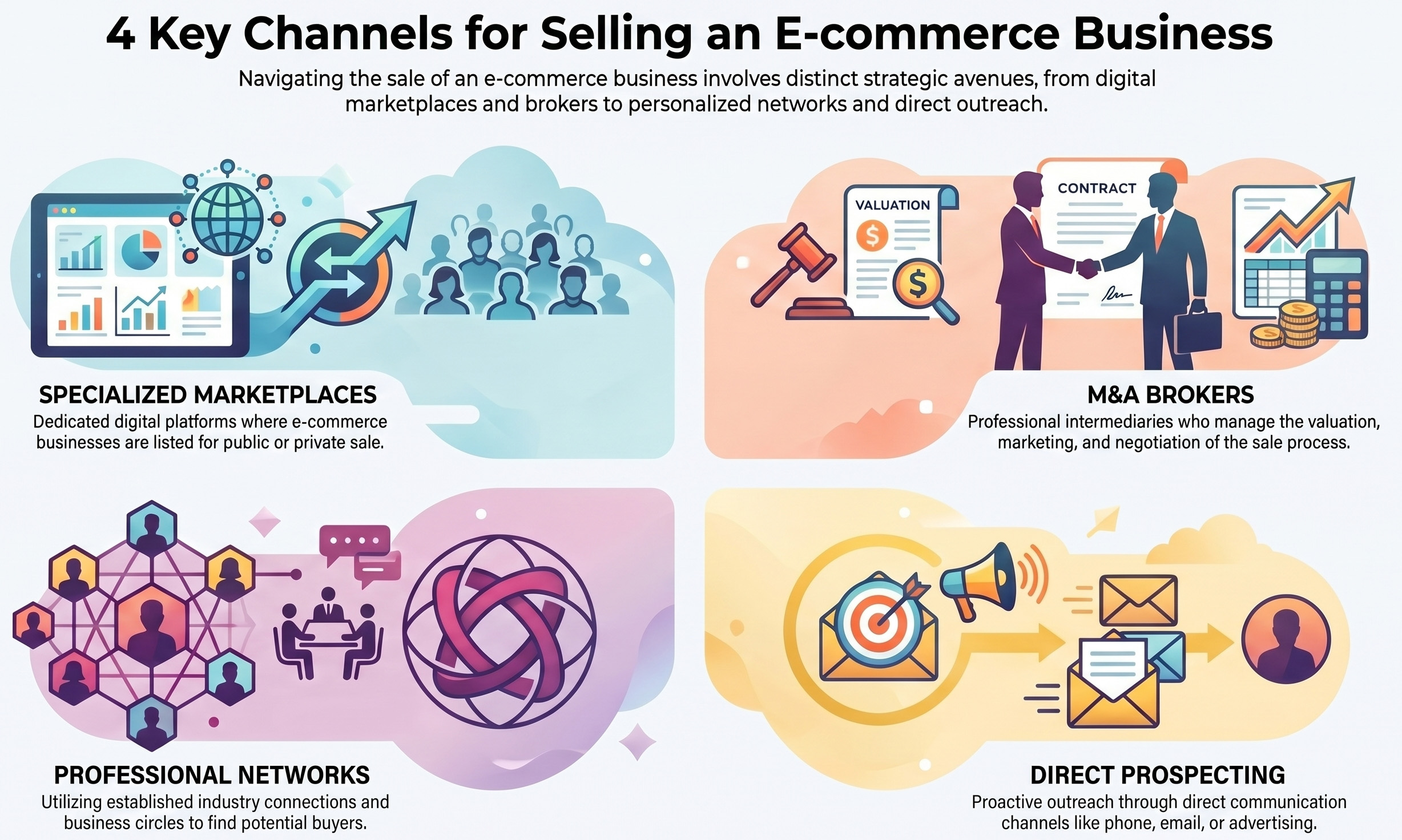
Marketplaces specialized in website sales
An e-commerce marketplace for sale provides a clear entry point to understand where to buy an e-commerce site. Platforms like Lunil structure the search with detailed site listings, verified sites, access to Analytics data, and secure payment via an escrow account. What this changes concretely: turnover, profits, traffic, and suppliers are documented upfront, reducing uncertainty at the time of negotiation.
Once this milestone is reached, it becomes simpler to compare multiple files on a consistent basis.
Concrete examples of e-commerce sites available for purchase
This logic is reflected in the listings published on Lunil, featuring e-commerce site opportunities that are already operational. In the pet niche, the pet e-commerce store runs on PrestaShop 8.2, features over 6,000 products, synchronizes stock in real-time, and shows a 40% margin.
In a different sector, the wine e-commerce site records €30,000 in annual turnover with an average basket of €150, active for five years.
Another scenario: the e-commerce site for sale in the gold jewelry space, offered turnkey with an established presence on Google Search Console.
Direct sourcing and professional networks
In addition to platforms, other channels exist to find an e-commerce site or find a site outside of public listings. Professional networks, the CRA, CCI takeover schemes, or certain entrepreneur masterminds bring forward more confidential opportunities, sometimes with less intermediation. The shift happens when the buyer looks for a direct relationship with the seller and a more flexible negotiation.
Direct sourcing from complementary players or competitors works on the same principle: a relationship without intermediaries and more flexible terms. It requires more time, but it can grant access to an e-commerce site for sale that does not appear on any platform. Keep a close eye on this if your goal is to identify low-visibility targets before they hit the market.
E-commerce due diligence before buying a site
Buying an existing e-commerce site cannot be secured solely on the basis of reported turnover. Without rigorous verification, buying a site exposes you to avoidable legal, financial, and technical risks. The first reflex should be to request a complete file: 12 months of monthly turnover, Analytics data, order volume, average basket, and relevant documentation provided by the seller.
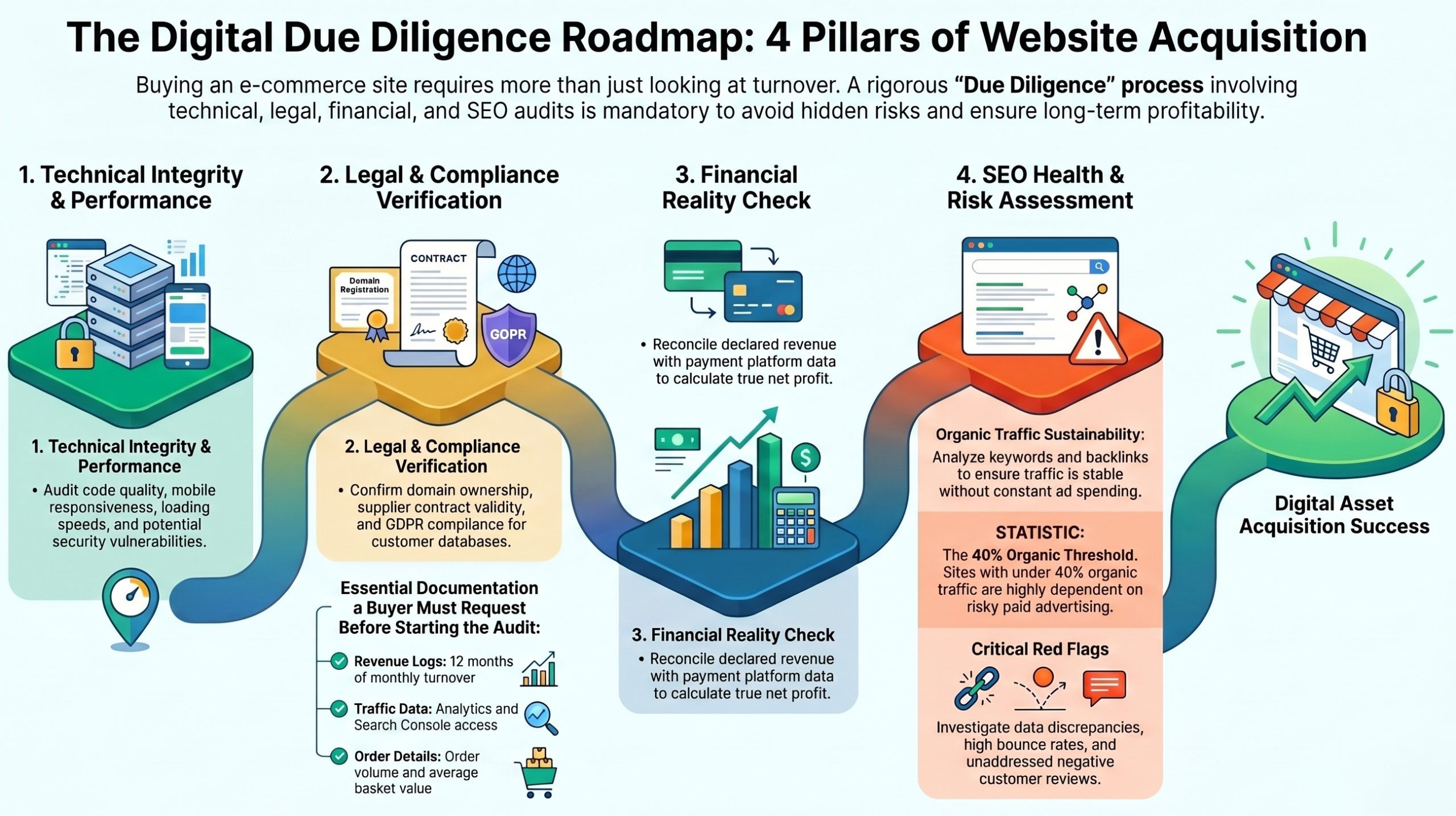
The technical, legal, and financial audit of the site
This e-commerce due diligence rests on three inseparable blocks: technical, legal, and financial. On the technical side, it is necessary to examine code quality, loading times, mobile display, and detectable security flaws.
- Legal verification: checking domain name ownership, GDPR compliance of the customer database, and the validity of supplier contracts.
- Financial analysis: cross-referencing declared income with data from payment gateways, calculating real net profit.
- Asset transfer: precisely defining the scope of what is sold, including source code, customer database, hosting access, payment gateways, and business assets.
Once this stage is cleared, the transaction must also be safeguarded. Demanding verifiable proof of income and arranging an escrow account protects both the buyer and the seller.
Simultaneously, the customer base must be accurately assessed: actual active size, retention, average basket, and the legal feasibility of transferring it with the online store.
SEO verification and organic traffic analysis
This pre-purchase website verification must then cover organic acquisition. Google Search Console, SEMrush, or Ahrefs allow you to analyze top keywords, backlink profiles, traffic trends over 12 months, and potential penalties. For an online business, the shift happens when SEO generates a stable stream, independent of constant advertising spend.
Conversely, very low search engine visibility may signal growth potential, but also a lack of foundations. It is therefore crucial to check product page optimization, metadata presence, and the overall indexing status.
Red flags and mistakes to avoid before the acquisition
Among the signs that should slow down or even stop the operation, the clearest are: discrepancies between stated figures and analytics tools, low indexing, abnormally high bounce rates, or unanswered negative customer reviews. The real question is whether revenues hold up without the currently active paid campaigns.
The threshold to watch is simple: less than 40% of traffic coming from organic search indicates a heavy reliance on Google Ads or Meta Ads. The moment these campaigns stop, revenue can drop sharply. To take over an e-commerce site in this context, you must factor in a substantial acquisition budget right from the start and reassess the true profitability of the e-commerce website project.
How to successfully buy an online e-commerce business
A solid acquisition is determined well before signing, and then during the first few weeks of the takeover. Buying an e-commerce site that is already operational accelerates market entry, recovers an existing audience, and builds on a business that has already proven itself.
Defining your strategy before buying an e-commerce site
Any serious e-commerce acquisition strategy begins with a clear investment thesis: why acquire, with what budget, under what model, and with what internal resources to run the online store after the takeover. The shift happens when these criteria are established even before finding a site.
- Clear objective: diversification, entry into a new market, or seeking a more passive income stream before considering an e-commerce site purchase.
- Total budget: acquisition price, potential redesign, technical fees, relaunch marketing, and transition costs.
- Consistent economic model: dropshipping with a potential margin around 40%, or an inventory-based model if logistics are mastered.
- Verified internal capabilities: a WordPress/WooCommerce store is not managed the same way as a PrestaShop store, depending on usage and the expected level of autonomy.
To buy a site better, you must integrate all expenses related to integration, and not just the price listed by the seller. What this changes concretely: buying an e-commerce site is approached as a global project, not just a simple transaction.
Negotiation, legal structuring, and transition
Once the framework is set, negotiation becomes much more concrete. To succeed in buying an e-commerce site, you must secure post-sale support from the seller, ideally for a year, as well as the transfer of all access: hosting, payment solution, analytics tools, ad accounts, supplier relations, and technical documentation. Watch closely: non-compete clauses and the exact handover terms.
The legal structure deserves the same level of attention. The operation can take the form of an asset transfer, a business asset takeover, or a 100% stock purchase of the company operating the e-commerce. Once this step is crossed, the tax implications and the transferred risks are completely different.
Taking over a site via a business asset purchase generally isolates the buyer better from past liabilities, whereas a stock purchase also carries the company’s liabilities. The real question is whether the transaction covers the assets useful to the business or the entire existing legal shell.
Mistakes to avoid after the acquisition
The most costly mistakes consist of overpaying based on flattering projections, neglecting the already established reputation, or underestimating the legal risks related to the transferred customer database. Buying a site also means moving quickly on positioning, visual identity, and customer experience continuity.
Conversely, a well-prepared transition helps preserve traffic and consolidate performance from the very first months. To buy a site under good conditions, you must verify that data, processes, and growth drivers are truly transferable—the quality of integration matters more than the opportunistic effect.
Frequently asked questions
How much does it cost to buy an existing e-commerce site?
The price of an e-commerce site depends primarily on its maturity, profitability, and the stability of its business. On specialized marketplaces, small e-commerce structures generally trade between €800 and €10,000, sometimes with split payments. As soon as we talk about buying a profitable existing e-commerce site, the valuation rises quickly: an existing e-commerce site that generates €2,000 in net monthly profit can sell for between €48,000 and €96,000, or 24 to 48 times that monthly profit.
Conversely, for a structured company, the reference often remains the adjusted annual EBITDA: in France, the observed range is between 2 and 5 times this metric. In practice, buying a site without having the figures reviewed by a certified accountant exposes you to an inaccurate reading of true profitability, hidden fees, or an overestimated margin.
Is e-commerce profitable to buy?
Buying an e-commerce site is often more predictable than launching from scratch, provided you verify the data before signing. A well-positioned dropshipping site can generate between €1,300 and over €2,500 in annual net profit. The stake is not just turnover, but the business’s capacity to maintain a healthy margin without over-relying on paid advertising.
This logic requires looking also at organic traffic quality, sales recurrence, and the level of daily operational intervention required. The shift happens when buying an existing e-commerce site allows you to take over a proven mechanism rather than a fragile promise. To buy a website under good conditions, check if revenue holds up without the constant presence of the seller.
Where can I find reliable listings of e-commerce sites for sale?
Specialized platforms for site listings remain the most direct entry point to spot an e-commerce site for sale. Lunil Marketplace lists offers with verified data: Analytics, Search Console, transaction history, and supplier information. This is often the most direct path to identify e-commerce site opportunities before buying a site.
In addition, digital M&A brokers, CCIs, and certain professional networks provide access to off-market listings. Once this step is completed, the rule remains the same: request a full transfer file and secure the payment via an escrow account.