


Are you considering buying or selling a website? Valuing a digital asset is not an exact science, but certain criteria can help establish a fair and realistic price. Here are the 7 essential factors to analyze.Before diving into these metrics, you must also learn to identify the five warning signs that can drive down the value of a website and ruin your investment.
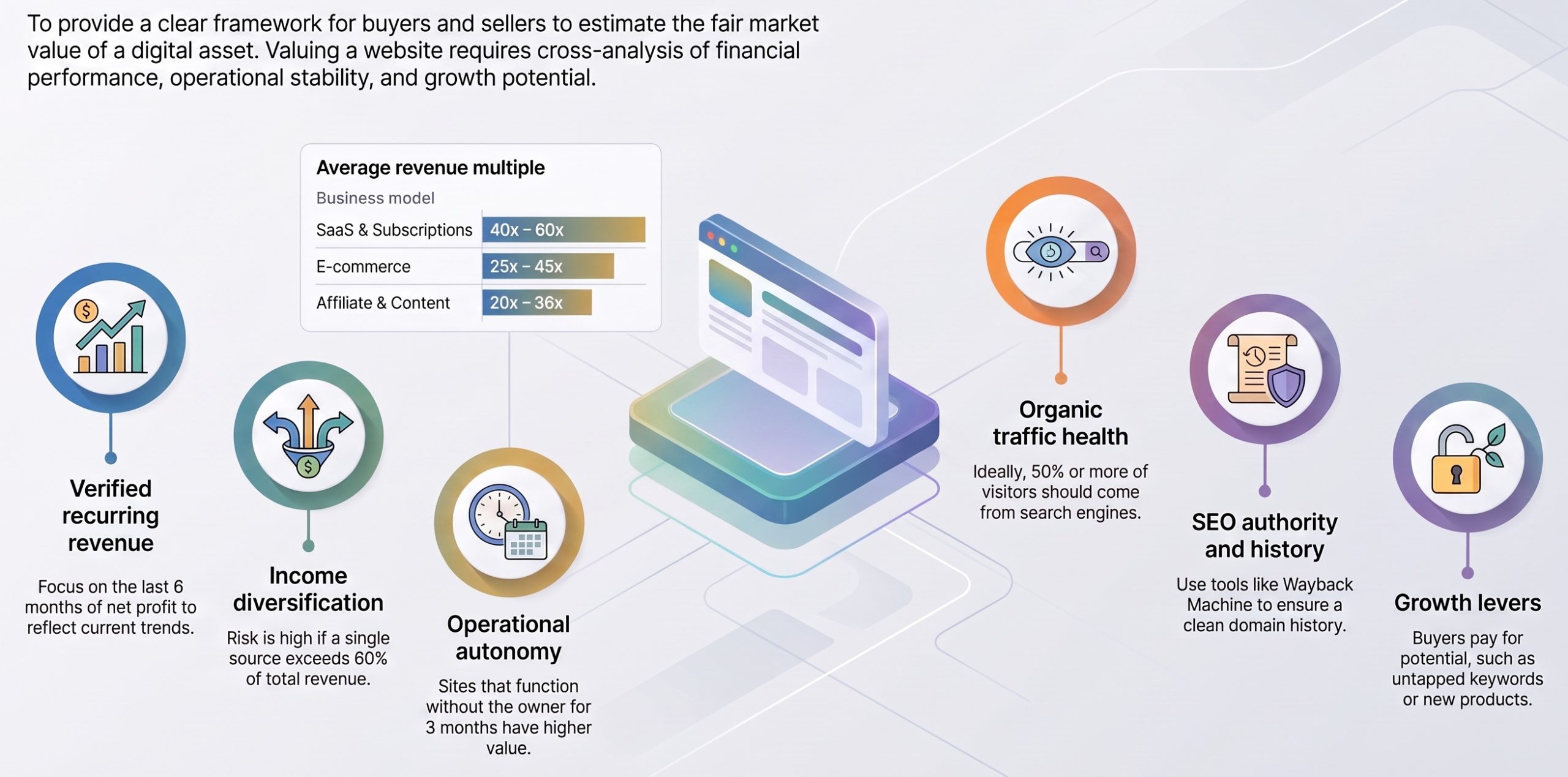
1. Recurring Monthly Net Revenue
The first step is to examine revenue over at least the last 12 months. Don’t simply rely on the figures provided: ask for proof. PayPal screenshots, bank statements, Google AdSense data… Everything should be verifiable.
Pro tip: Calculate the average of the last 6 months rather than the full year. This provides a more up-to-date view, especially if the website is growing or declining.
2. Stability and Diversification of Revenue Sources
A website that depends on a single revenue source for 90% of its income carries a high level of risk. What happens if Google changes its advertising algorithm or the only affiliate partner suspends its program?
The highest valuations generally apply to websites with multiple revenue streams: display advertising, affiliate marketing, proprietary products, services, and subscriptions. This diversification reassures buyers and justifies a higher multiple.
Practical advice: Prioritize websites where no single revenue source accounts for more than 60% of total revenue.
See websites for sale on LUNIL
3. Organic Traffic and Its Quality
Visitor volume remains crucial, but quality matters more than quantity. 10,000 highly targeted monthly visitors are often worth more than 50,000 visitors with low engagement.
Analyze these key metrics:
- Share of organic traffic (ideally 50%+ coming from search engines)
- Bounce rate (the lower, the better)
- Average session duration
- Pages viewed per visit
4. Domain Age and SEO Authority
An established domain with a good reputation is a major asset. Google tends to trust websites that have been established for several years. Check the domain’s history: has it always hosted the same type of content? Has it ever been subject to penalties?
Important SEO indicators include Domain Rating (Ahrefs), Domain Authority (Moz), and the number of quality backlinks. A website with high authority can rank more easily for new keywords.
Essential tool: Use Wayback Machine to review the website’s history and identify any potentially suspicious changes.
5. The Revenue Multiple Applied According to the Industry
The famous “multiple” varies considerably depending on the type of website and its niche:
- Affiliate websites: 20 to 35x monthly revenue
- E-commerce: 25 to 45x depending on revenue recurrence
- SaaS and subscription businesses: 40 to 60x (highly predictable revenue)
- Content/advertising websites: 24 to 36x
Factors that increase the multiple: Consistent growth, automated processes, a strong brand, high barriers to entry.
Factors that decrease the multiple: Dependence on one person, a saturated market, declining revenue, heavy technical maintenance.
6. Workload and Operational Autonomy
A website generating €3,000/month but requiring 40 hours of work per week is worth less than a website generating €2,000/month that operates completely autonomously. Buyers are looking for “passive income” businesses or businesses requiring minimal time investment.
Honestly assess the time required for content creation, customer management, technical updates, and after-sales support. The more independently the website operates, the higher its value.
7. Identified Growth Potential
Experienced buyers don’t just pay for current performance; they also pay for future potential. A well-positioned website in a growing niche with obvious opportunities for improvement will command a higher price.
Identify and document growth opportunities: new keywords to target, products to launch, geographic markets to expand into, and simple technical optimizations to implement.
Bonus for sellers: Prepare a document listing 5 to 10 concrete ideas for growing the website. This reassures the buyer about their ability to generate a return on their investment.
Website valuation therefore remains a delicate exercise combining objective data and projections. Never rely on a single criterion: true value emerges from a cross-analysis of all these factors.
And remember: ultimately, a website is only worth what a buyer is willing to pay. In a dynamic market, negotiation often remains the final decisive step.








How do you quantify growth potential? It seems subjective and buyers might overpay for ‘potential’.
Great breakdown! But how do you handle the valuation when the site’s revenue is lumpy due to seasonal spikes? Any rule of thumb?
What’s the best tool to verify a domain’s past penalties? Wayback doesn’t show everything.
The autonomy point is huge. I bought a site that needed daily management and it killed my free time.
In my experience, the revenue multiple is the most negotiable factor. Everything else is just supporting evidence.
The multiple range for SaaS seems low. I’ve seen healthy SaaS sites sell for 80x monthly revenue.
What if the site has great traffic but no revenue yet? Is it worth anything?
I disagree with using only organic traffic share as a key metric. Some sites thrive on paid traffic with high ROI. What about that?