


What you will find in this article
A no-nonsense breakdown of the hidden warning signs that undermine the valuation of your online platform. Discover the five critical metrics scrutinized during due diligence by experienced investors, from extreme SEO dependence to an imbalanced LTV/CAC ratio, as well as how to clean up your performance indicators before entering negotiations.
A no-nonsense breakdown of the hidden warning signs that undermine the valuation of your online platform. Discover the five critical metrics scrutinized during due diligence by experienced investors, from extreme SEO dependence to an imbalanced LTV/CAC ratio, as well as how to clean up your performance indicators before entering negotiations.
On paper, your business is firing on all cylinders. The dashboard shows steady growth, your annual revenue boosts your confidence as an entrepreneur, and you are already imagining applying a record valuation multiple when selling your digital business. You prepare your sales package enthusiastically, convinced that the market will fight over your project at a premium price.Once you know how to spot these red flags, make sure you also master the 7 essential criteria for estimating the value of a website to secure a profitable deal.
Then comes the real test: facing professional buyers.
These experienced buyers, investment funds, and business angels do not stop at the storefront. They do not look at your project through the founder’s optimistic eyes, but through the unforgiving lens of risk management. With a few clicks in your audience analytics tools and payment gateways, they uncover underlying data you may never have monitored. Within forty-eight hours, the theoretical valuation of your digital asset can collapse. Here is an exact breakdown of the five warning signs that drive buyers away before they even make a firm offer.
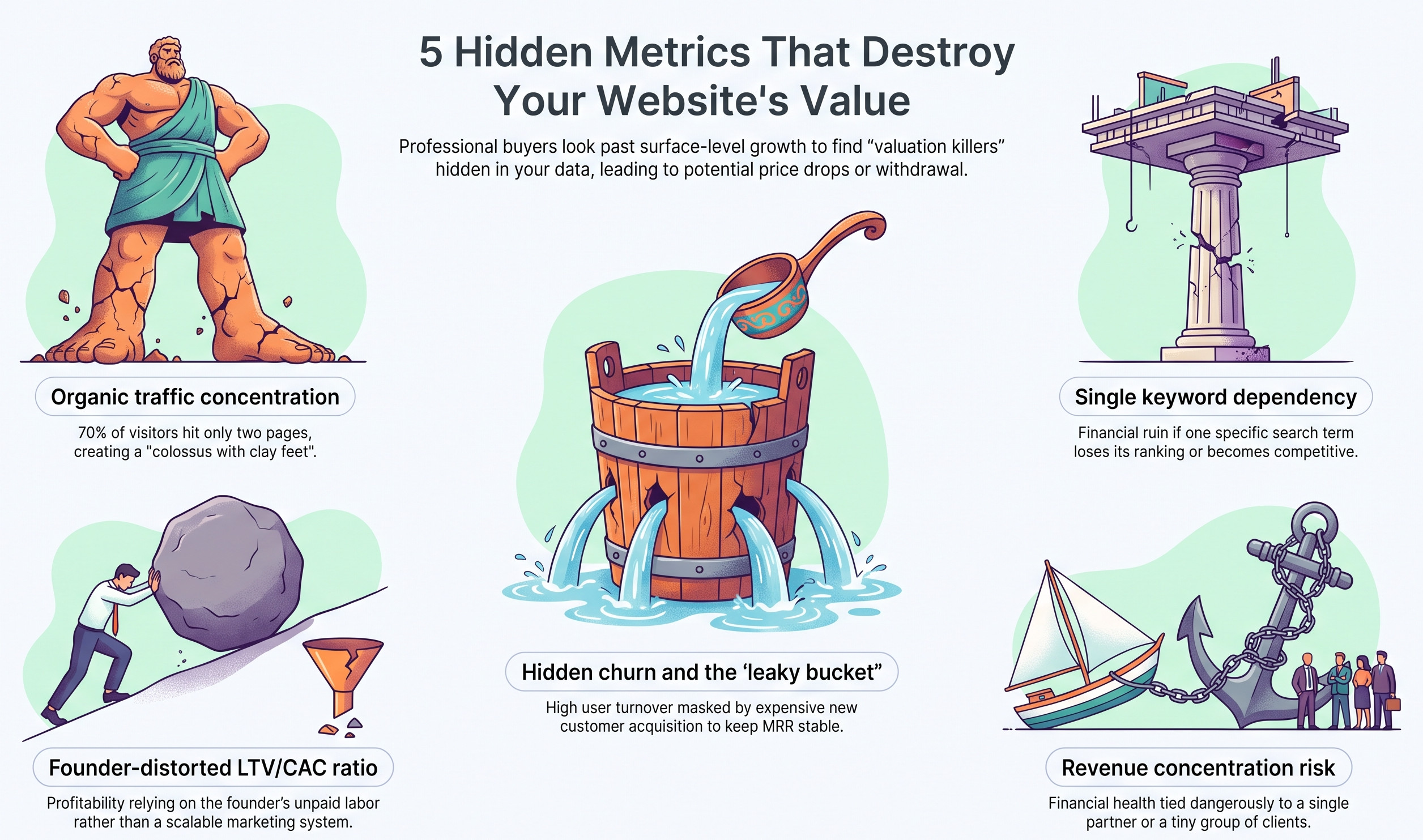
1. Organic traffic concentrated on a handful of URLs
Showing 150,000 monthly unique visitors in your Google Analytics report is a respectable achievement. Yet, for an experienced buyer, raw volume means nothing without a detailed analysis of how that audience is distributed.
If your Search Console analysis reveals that 70% of your sessions come from two blog posts or a single landing page, your website does not represent a solid business: it is a giant with feet of clay. What happens when the search engine rolls out its next algorithm update or a direct competitor publishes more comprehensive content?
Such concentration creates a permanent Sword of Damocles over future cash flows. The buyer knows that a simple algorithmic penalty or the loss of a rich result can destroy the business model’s profitability overnight. Faced with this vulnerability, the reaction is predictable: either they immediately walk away from the talks, or they demand a punitive 30% to 50% discount on the sale price to compensate for this operational risk.
2. Critical dependence on a single strategic keyword
Closely related to page concentration, keyword dependence is a classic trap when valuing a media site, e-commerce portal, or affiliate website.
Sellers like to highlight their top position for a generic, high-search-volume query. But for a rational investor, this is a source of concern. Serious audits scrutinize ranking history:
-
What proportion of conversions comes directly from this single keyword?
-
Does the domain have broad topical authority, or is it benefiting from a temporary ranking anomaly?
-
What share of traffic comes from branded searches compared with non-branded queries?
A sustainable digital business relies on a diversified long tail and a strong brand profile. If all your sales depend on the survival of a single keyword exposed to Google Ads bidding volatility or the arrival of aggressive new competitors, your valuation multiple will automatically be anchored to the most pessimistic scenario.
3. Hidden churn and declining cohorts
For creators of micro-SaaS products, subscription websites, or paid communities, monthly recurring revenue (MRR) is the key metric. Yet it is also fertile ground for accounting illusions.
Let me explain. Recurring revenue can often appear stable simply because the founder is constantly injecting fresh money into acquiring new members. But when you isolate cohorts of users who signed up six months earlier, the truth emerges: the churn rate is hemorrhaging.
Stable revenue = (Expensive new subscriptions) - (Massive unreported cancellations)
A buyer does not want to purchase a leaky bucket that they will have to refill every morning with costly advertising. Once cohort analysis shows that customer retention weakens after ninety days, the multiple applied to annual net profit can plunge from 5x to 2x. The business model is no longer seen as a high-value standalone software product, but as an exhausting marketing machine that will stop as soon as the media budget is cut.
4. An unstable LTV/CAC ratio distorted by the founder’s work
The fundamental growth equation for a web business is based on the balance between customer lifetime value (LTV) and customer acquisition cost (CAC). A healthy ratio for an online business is generally around 3:1: every euro invested in acquisition generates at least three euros of gross margin over the lifetime of the account.
During financial due diligence, auditors recalculate this ratio with surgical precision. The two common anomalies that can derail a sale are:
-
Underestimated acquisition cost: The seller fails to include in CAC the dozens of hours personally spent prospecting on LinkedIn, writing newsletters, or manually managing a community without paying themselves appropriate compensation.
-
Progressive deterioration of acquisition campaigns: CAC has jumped 60% over the past two quarters as social media audiences have become saturated, compressing net operating margin.
-
When a buyer discovers that the model only works thanks to the outgoing founder’s unpaid involvement, or that the marginal acquisition cost exceeds the average profitability of an account, the promise of passive profitability disappears.
5. Revenue concentrated on one partner or a handful of clients
Customer concentration risk applies to online businesses with formidable force. Whether you run an affiliate platform, an e-commerce website, or a digital agency, an asymmetric distribution of cash flows immediately raises red flags with investment committees.
| Revenue stream structure | Buyer’s assessment | Impact on the acquisition offer |
| More than 40% generated by a single B2B client | Risk of failure if the client leaves after the sale | Large earn-out clause or breakdown of negotiations |
| 80% of commissions tied to a single affiliate program | Total dependence on a third party’s terms (e.g. rate reduction) | Immediate discount to the valuation multiple |
| Highly diversified customer base (no account represents more than 3%) | Resilient model, high predictability of future revenue | Retention or negotiation of a valuation premium |
If a single unilateral decision by an account manager at a major affiliate partner can cut your net profit in half, you do not own an independent business: you are a vulnerable subcontractor.
The concrete impact of risk metrics on your final valuation
To visualize the devastating effect of these overlooked metrics, consider the practical example of a content website generating €50,000 in annual net profit:
Case A: Healthy and diversified asset
Profit: €50,000 × 3.5 multiple = €175,000 net to the seller.
Traffic distributed across 200 pages, with revenue from 5 distinct channels.
Case B: Uncleaned high-risk asset
Profit: €50,000 × 1.8 multiple (48% risk discount) = €90,000.
80% of traffic from 1 keyword, single affiliate program, extreme dependence.
Net loss for the seller: €85,000 lost during the negotiation.
The LUNIL solution: certify the health of your asset before the sale
 Discovering these weaknesses in the middle of negotiations puts the seller in an untenable position. To avoid fruitless negotiations and last-minute renegotiations, preparation well in advance is essential.
That is exactly the purpose of the marketplace LUNIL.
Rather than basing your sale price on fragile assumptions, LUNIL directly synchronizes your real metrics — verified Google Search Console data, banked Stripe transaction histories, and traffic analytics. By publishing your digital asset under the “clean certified” label on LUNIL, you demonstrate the diversification of your traffic sources, the authenticity of your conversions, and the strength of your operating margin. You avoid time-wasting buyers and negotiate on equal footing with qualified investors who are ready to pay a fair market price for the quality of your work.
Frequently asked questions about website due diligence
How long before putting a website up for sale should you audit its metrics?
Ideally, you should begin this assessment at least six to twelve months before putting the asset on the market. This timeframe allows you to diversify traffic sources, publish new content to dilute dominant pages, and stabilize churn over several consecutive quarters.
Does a high churn rate necessarily prevent a sale?
Not necessarily, provided you adapt your sales narrative. If your churn is high but your monetization model offsets this loss through a high first-order value or strong initial profitability, explain this reality clearly. What drives investors away is not churn itself, but the attempt to conceal it.
How can you prove that profits are not dependent on your personal time?
Keep an operational log of your weekly involvement during the three months preceding the sale. By documenting all business processes (SOPs) and showing that technical maintenance, server management, and customer support require only a few hours per week, you can fully reassure the buyer about the viability of the transition.








The founder’s unpaid work being excluded from CAC is a classic mistake. Buyers will add that back and slash your valuation.
Customer concentration is also a big issue for e-commerce. If one supplier or client is >20%, it’s risky.
Great breakdown. I’d also add that a lack of documented processes can be a red flag. Buyers want a business that runs without you.
Revenue concentration on one affiliate program is a huge red flag. I always advise diversifying across at least 3-4 programs.
What about seasonality? If a site has huge Q4 sales, does that affect valuation?
Hidden churn is so true. I used to mask it with aggressive ads. Once I stopped, MRR plummeted. Buyers see right through it.
Earn-out clauses can be a lifesaver for buyers when there’s client concentration. But sellers often hate them.
The example with €50k profit and 48% discount is eye-opening. I need to audit my site before even thinking of selling.
This article is a wake-up call. I’m going to start cleaning up my metrics now, even though I’m not selling yet.
I have 100k visitors but from 500 pages. Is that diversified enough?
I have a blog with 70% traffic from Pinterest. Is that a red flag?
The LTV/CAC ratio can be manipulated by including organic traffic as ‘free’ acquisition. Buyers will adjust it.
Great article! I never thought about how a single blog post could tank my site’s value. Time to diversify my content.
Keyword dependence is a killer. I’ve seen sites with one main keyword crash after a competitor outspent them on ads.
What’s a reasonable LTV/CAC ratio for a small SaaS? Is 3:1 always the target?
What tools do you recommend for cohort analysis? I use Google Analytics but it’s limited.
The LUNIL solution sounds interesting. I’ll check it out. Thanks for the practical advice!
The 48-hour collapse in valuation is real. I’ve seen deals go from $1M to $500k after due diligence.
How long before selling should I start preparing? I’m thinking 6 months, but maybe a year is better.
Does the LUNIL marketplace only work for websites in Europe? I’m based in the US.