

In today’s web ecosystem, we are witnessing a paradoxical “scarcity economy” amid content overabundance. For media investors and digital entrepreneurs, the background noise has become deafening: millions of generic articles are published daily, often with no other purpose than capturing a fleeting click. Yet, amid this sea of mediocrity, a centuries-old institution has executed a spectacular turnaround.
In 2023, The New York Times (NYT) reached a historic milestone: digital subscription revenue surpassed the symbolic $1 billion mark for the first time. With 10.36 million subscribers across 233 countries, the group no longer merely reports the news; it dominates a Total Addressable Market (TAM) estimated at 135 million curious, English-speaking adults willing to pay for real value.
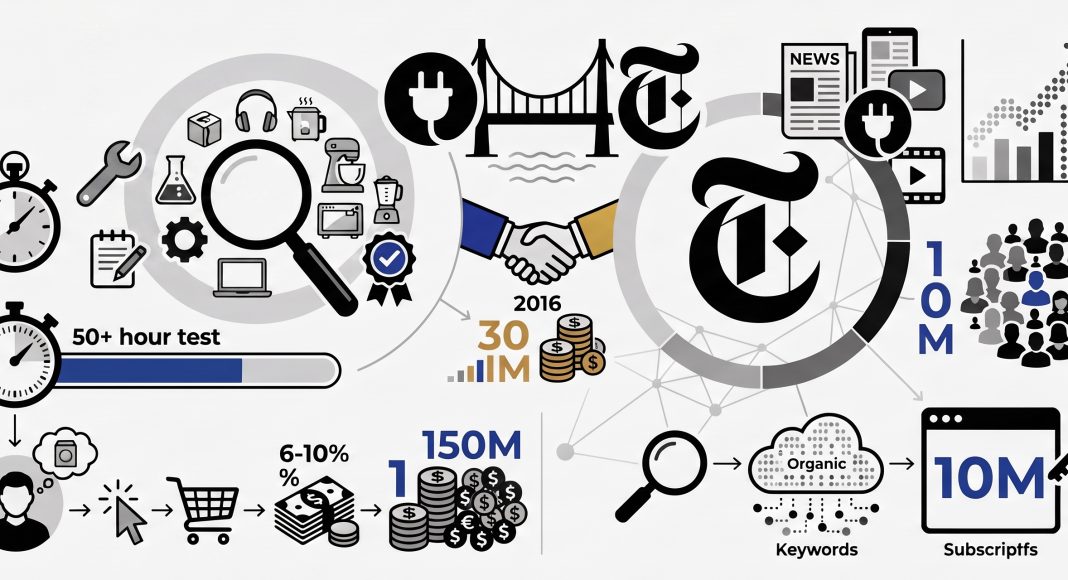
The central pivot of this success? The bold 2016 acquisition of The Wirecutter and its sister site, The Sweethome, for over $30 million. By merging both entities under the single Wirecutter brand, the NYT proved that trust is the 21st century’s most profitable asset. Here are the five strategic levers, analyzed through the lens of key takeaways and return on experience, to build an unassailable digital fortress.
1. The “SEO Moat”: YMYL Expertise as a Barrier to Entry
Wirecutter’s success rests on a deep understanding of search algorithms, particularly the E-E-A-T framework (Experience, Expertise, Authoritativeness, Trustworthiness). In SEO terms, Wirecutter is a YMYL (Your Money or Your Life) site: its recommendations directly affect readers’ finances. Consequently, Google applies far more stringent standards here than elsewhere.
Where competitors push out 2,000-word “Top 10” lists in a matter of hours, Wirecutter builds a true defensive moat. The organization produces 10,000 to 17,000-word guides backed by costly R&D that AI cannot replicate.
- Embodied Expertise: Take Tim Heffernan. To write the air purifier guide, he did not just read spec sheets; he tested the units for years in his own apartment, gathering objective scientific data.
- Proof of Authority: Author bios are not mere footnotes. They detail decades of experience, link to prior work, and prove to algorithms that a human expert stands behind every word.
This approach transforms content into a high-value fixed asset, virtually impossible to displace from top Google rankings.
2. The Courage of Conviction: Taking a Stand to Reduce Decision Fatigue
A common mistake among web operators is hiding behind sterile neutrality. Maximizing conversion and retention requires taking a stand. Readers do not visit Wirecutter for an encyclopedia; they come for an answer.
While most comparison sites list ten products while remaining noncommittal, Wirecutter makes the call. By unequivocally naming the Steelcase Gesture the best office chair, the site instantly eliminates user decision fatigue.
“By creating a single brand and destination for everything our readers are looking to buy, we believe we can make Wirecutter to product reviews what The Times is to journalism: the most trusted, authoritative, and definitive source.”
— David Perpich, President of Wirecutter
This decisive positioning amplifies perceived value. By serving as a decision engine, Wirecutter does not merely sell an affiliate click; it sells time and peace of mind. This powerful psychological lever converts casual visitors into recurring users.
3. The Power of the “Bundle”: Turning an Audience into an Ecosystem
The NYT’s 2023 annual report is a masterclass in Lifetime Value (LTV) optimization. The group’s strategy no longer relies on a single product, but on an interconnected suite: News + Games + Cooking + Wirecutter + The Athletic.
The Bundle has become the primary growth engine:
- Massive Engagement: Games were played over 8 billion times in 2023. It represents the ultimate top-of-funnel asset: a high-frequency, low-friction product that integrates users into the ecosystem.
- Churn Reduction: By the end of 2023, 41% of subscribers consumed multiple products or held the “All Access” bundle. Multi-product subscribers are statistically far less likely to cancel than single-product users.
- Higher ARPU: By driving cross-traffic between Cooking recipes and Wirecutter reviews, the group maximizes Average Revenue Per User while optimizing customer acquisition costs.
The takeaway for media strategists is straightforward: long-term survival demands building an interconnected daily habit.
4. Monetization Rooted in Rigor and Radical Transparency
Affiliate marketing is often criticized for lacking transparency. Wirecutter reversed this paradigm, demonstrating that honesty is the strongest long-term conversion driver. The site drives over $150 million in annual sales, taking a 6% to 10% commission cut.
However, this monetization is governed by strict editorial standards. The publication routinely discourages segments of its audience from buying when a product is unnecessary. For instance, its office chair guide explicitly notes that spending $1,000 makes little sense if you sit at a desk for under six hours a day.
This radical transparency establishes deep trust. Readers know that when Wirecutter recommends a product, it has survived rigorous stress-testing. For investors, this translates into lower return rates and brand equity that money alone cannot buy. Profit is not the primary objective; it is the byproduct of editorial integrity.
5. Defending Intellectual Property Against Generative AI
We are navigating a major shift in the data economy. The NYT has led legal challenges against OpenAI, Microsoft, and Perplexity to protect its proprietary content. This is not merely a defensive posture; it is a core value-preservation strategy.
The group challenges “uncompensated substitution,” where AI platforms ingest Wirecutter research and NYT reporting to deliver direct answers, capturing value without directing traffic back to the source.
- The Risk of “Hallucinations”: Attributing fabricated details to a trusted brand like the NYT damages a reputation built over 173 years.
- Protecting the Moat: The message to investors is clear: if content can be easily replicated by an LLM, the underlying business model is obsolete. But if content relies on hands-on physical testing and verified human expertise, it represents proprietary IP that AI may scrape, but cannot replace.
Defending content today ensures the 15 million subscribers targeted by 2027 will still have a compelling reason to pay for the original rather than settle for an AI summary.
Moving Toward a High-Quality Web
The rise of The New York Times and Wirecutter shows that the future web will bifurcate into two distinct spaces: a vast sea of generic, AI-generated filler, and resilient strongholds of trust, expertise, and verified reporting.
Media investment is no longer a race for raw page views, but a search for tangible value and trust. Success lies in building an ecosystem where every product (News, Cooking, Games) reinforces the whole, while fiercely safeguarding informational integrity.
For entrepreneurs and operators, the critical question remains: in an era where AI can summarize anything instantly, does your platform offer insights valuable enough that others cannot afford not to cite them?
To truly scale your media presence and replicate this kind of success, you must look into secondary digital markets for portfolio diversification and acquire niche authorities.








The ‘SEO moat’ via E-E-A-T is real. Google’s algorithm updates are crushing thin content. You must demonstrate real experience, not just aggregate specs.
Took them long enough to realize that quality journalism and product reviews are the same thing: building trust. Paywalls work if you deliver value.
The courage to take a stand is so underrated. Most sites are terrified of alienating anyone. Wirecutter’s ‘best for most people’ approach is brilliant.
The 10,000-word guide model is impossible for small sites. You need a team and a massive budget to test products for years. Not scalable.
O modelo de negócios do NYT é fascinante. Mas será que funciona em mercados menores? A barreira de entrada é altíssima.
Great breakdown, but isn’t the $1 billion milestone largely due to the Sports bundle? Seems like Wirecutter gets too much credit here.
Point 5 is the key. If your content can be summarized by an AI, you’re done. The NYT lawsuit is a warning shot to all publishers.
The 41% multi-product subscriber stat is wild. It proves that habit-forming products like Games are the ultimate retention tool. Worth the investment.