


What you’ll find in this article
- A comprehensive guide to the best e-commerce buying and selling platforms
- The different legal structures for an acquisition
- Financial valuation methods for e-commerce businesses
- How to determine normalized EBITDA and bridge Enterprise Value to Equity Value
- Practical tips for completing your digital acquisition safely
Did you know that some niche websites and specialized online stores sell for millions of dollars, while other businesses that look polished on the surface never find a buyer? In the digital economy, buying or selling an online business requires much more than simply putting a website up for sale.
Whether you’re an entrepreneur looking to monetize years of hard work or an investor seeking sustainable returns, understanding the market, identifying the right intermediaries, and mastering financial due diligence and valuation principles are your best defenses against a disappointing acquisition.
Asking where to buy a profitable e-commerce business involves much more than a simple Google search. You need to understand the online business acquisition ecosystem, uncover accounting issues, verify the underlying economics, and legally protect the transfer of the business and its digital assets.
The Best Platforms for Finding a Profitable Online Business
The market for buying and selling online businesses has become increasingly professional over the past decade. Today, you can broadly distinguish between two types of players: open marketplaces, where the volume of listings is the main attraction, and selective brokers, which screen businesses more carefully and focus on financially viable companies.
| Marketplace Type | Main Platforms (U.S. & Global) |
|---|---|
| Selective (Strict financial & operational vetting) |
|
| Open (High volume & micro-acquisitions) |
|
The Major Global Marketplaces for Buying Online Businesses
If you’re comfortable operating in English, the U.S. and international markets offer access to a much larger pool of acquisition opportunities:
- Flippa: One of the world’s largest marketplaces for digital businesses, ranging from small websites and content businesses to established e-commerce brands.
- Empire Flippers: A major marketplace focused on established, higher-value online businesses, with financial and operational screening before businesses are listed.
- QuietLight & Motion Invest: QuietLight focuses on established online businesses, including e-commerce and SaaS companies, while Motion Invest specializes primarily in smaller content and affiliate businesses.
- Acquire: A U.S.-based marketplace known primarily for technology startups, SaaS businesses, apps, and other digital companies.
Business Models and Transaction Fees
Online business marketplaces generally make money through success fees based on the final transaction value, often in the range of 5% to 15%, depending on the platform and deal size. Some platforms may also charge listing fees, subscription fees, or premium-access fees for buyers.
Before choosing a marketplace, compare not only the headline commission but also the quality of the due diligence, buyer network, transaction support, escrow arrangements, and post-closing assistance.
M&A Support and Legal Structures for an Acquisition
When an acquisition is worth several hundred thousand dollars or more, transactions with significant financial or operational complexity often benefit from an experienced M&A advisor or business broker specializing in digital companies.
Specialized firms such as Storybee can help bridge this operational gap through technical due diligence, financial reconstruction, confidential information memorandums, and targeted introductions to qualified buyers.
For a balance between speed and transaction security, using a dedicated e-commerce business marketplace can provide access to screened opportunities while helping coordinate the closing process and the transfer of digital assets.
                    DIGITAL ACQUISITION STRUCTURES
                                │
        ┌───────────────────────┼───────────────────────┐
        ▼                       ▼                       ▼
   Asset Purchase         Business Asset Sale       Equity Purchase
 (Domain, code,          (Customers, inventory,    (Shares or LLC
  brand, inventory)       contracts, goodwill)      membership interests)
        │                       │                       │
        └───────────────────────┼───────────────────────┘
                                ▼
                         IP / Brand License
                    (Right to use brand or technology)
When structuring an acquisition, buyers generally consider several possible approaches:
- Asset purchase: The buyer acquires specific assets such as the domain name, website, software, customer database, inventory, trademarks, or other intellectual property rather than purchasing the entire company.
- Purchase of the operating business: The transaction transfers the assets and goodwill necessary to continue operating the business, potentially including inventory, customer relationships, contracts, intellectual property, and other operating assets.
- Equity purchase: The buyer acquires the shares of a corporation or membership interests of an LLC, effectively taking ownership of the existing legal entity, including its assets, contracts, cash, and historical liabilities, subject to the transaction terms and applicable law.
- IP or brand licensing: Instead of purchasing the business outright, the buyer obtains contractual rights to use a brand, technology, software, or other intellectual property in exchange for royalties or other fees.
Important: The tax, liability, and contractual consequences of an asset purchase versus an equity purchase can differ substantially in the United States. Buyers should have the transaction reviewed by qualified legal and tax professionals before closing.
Browsing marketplaces is just the first step; your success ultimately depends on applying the 7 essential criteria for estimating the value of a website before signing any transfer agreement.
How to Determine the Fair Value of an E-Commerce Business
Valuing an online business requires looking beyond revenue alone. The objective is to estimate what a knowledgeable buyer would reasonably pay based on the company’s earnings, growth prospects, risks, assets, and comparable transactions.
The Importance of Comparable Transactions
One of the most practical approaches in the U.S. market is to compare the business with similar companies or recently completed transactions.
A useful comparable should ideally meet several criteria:
- Similar business model: Comparable revenue sources, margins, customer acquisition channels, and operating structure.
- Similar size: Comparable revenue, EBITDA, traffic, customer base, and transaction value.
- Recent transaction: More recent transactions generally provide a better indication of current market conditions.
- Comparable operating risk: Similar dependence on paid advertising, SEO, a single supplier, a founder, or a small number of customers.
Financial Normalization: Finding the Business’s True Profitability
To determine the underlying profitability of an e-commerce business, buyers should normalize the financial statements by removing unusual, personal, or non-recurring expenses and adjusting owner-related costs to reflect the business’s future operating structure.
Normalizing Owner Compensation and Operating Expenses
- Adjust owner compensation to a reasonable market level based on the role the owner will continue to perform after the acquisition.
- Remove personal or discretionary expenses that are not required to operate the business.
- Identify unusual legal, consulting, marketing, or technology expenses that are unlikely to recur.
- Separate one-time expenses from recurring operating costs.
From Reported EBITDA to Normalized EBITDA
A buyer should not automatically accept the EBITDA presented by the seller. The goal is to calculate a normalized EBITDA that better represents the sustainable earnings of the business after the acquisition.
Potential adjustments may include:
- Removing non-recurring expenses that are unlikely to occur again.
- Adjusting owner-related compensation to reflect the actual staffing structure required after closing.
- Removing personal or discretionary expenses that do not contribute to ongoing operations.
- Normalizing unusual income or government incentives when they are not expected to continue.
- Adjusting for exceptional events that temporarily inflated or reduced earnings.
The Often-Underestimated Impact of Normalized Working Capital
In e-commerce, inventory seasonality can hide the company’s actual cash requirements. A buyer should therefore estimate a normalized working capital requirement, ideally based on several months or a full year of operating data.
This analysis can be particularly important for businesses that need to purchase inventory well before collecting cash from customers.
From Enterprise Value to Equity Value
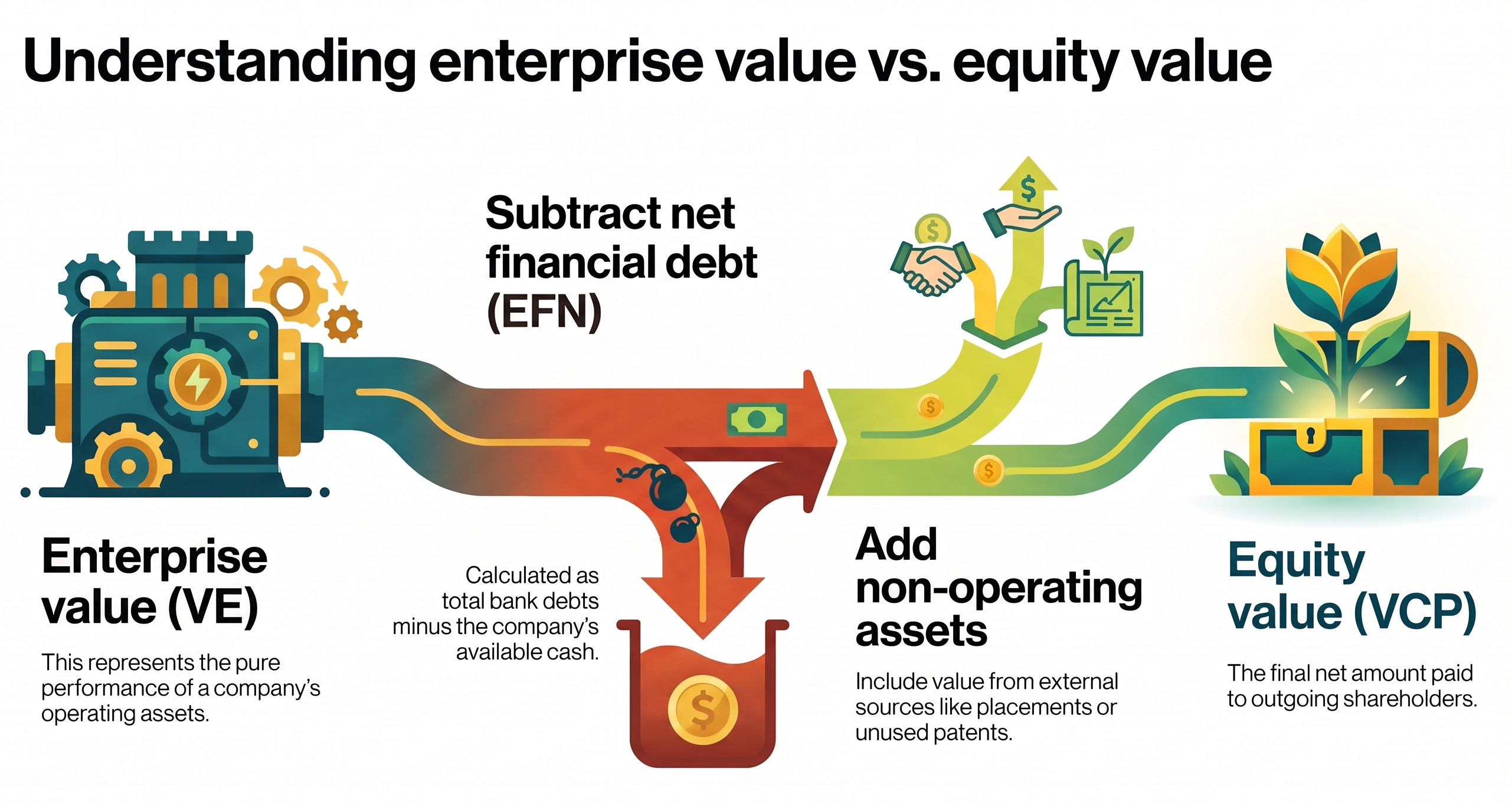
The key distinction can be summarized as follows:
Equity Value = Enterprise Value − Net Debt + Non-Operating Assets
Net debt generally includes interest-bearing debt and similar financial liabilities, reduced by excess cash and cash equivalents. The exact definition should be established in the purchase agreement.
For example, a business could have an Enterprise Value of $2 million, $400,000 in net debt, and $100,000 in qualifying non-operating assets. Its implied Equity Value would be approximately $1.7 million.
The Gordon Growth Model
For mature businesses with relatively predictable long-term cash flows, a perpetual-growth approach can also be used as part of a broader valuation analysis:
Enterprise Value = Normalized Cash Flow × (1 + g) / (r − g)
- g: Long-term sustainable growth rate.
- r: Required rate of return, reflecting the risk associated with the business, including size, concentration, key-person dependence, illiquidity, and other factors.
This model is generally more useful for established businesses with relatively predictable cash flows than for young, rapidly changing e-commerce companies.
Tools and Tips for Successfully Buying an Online Business
- Request independent traffic verification using read-only access to Google Analytics, Google Search Console, advertising accounts, and other relevant analytics platforms.
- Review logistics and suppliers carefully, including return rates, inventory turnover, supplier concentration, payment terms, and supply agreements.
- Use an escrow arrangement for the purchase funds when appropriate, particularly when digital assets and account credentials are being transferred at closing.
- Verify the transferability of advertising accounts, including Meta Ads, Google Ads, pixels, historical account performance, and any previous policy restrictions.
- Check the transferability of key digital assets, including domains, trademarks, social media accounts, software licenses, customer databases, and supplier agreements.
- Negotiate a transition period of approximately 30 to 60 days when the business depends heavily on the seller’s knowledge or relationships.
- Verify the financial statements against bank statements, payment processors such as Stripe and PayPal, accounting records, and applicable tax filings.
Frequently Asked Questions About Buying Profitable Websites
How many times annual profit does an e-commerce business typically sell for?
There is no single standard multiple for every e-commerce business. Depending on size, growth, margins, brand strength, customer concentration, owner dependence, traffic sources, and other risks, online businesses can trade at very different multiples.
For smaller owner-operated businesses, buyers may focus on Seller’s Discretionary Earnings (SDE), while larger and more professionally managed businesses are often evaluated using EBITDA.
As a result, the appropriate valuation multiple should be determined from comparable transactions and the specific characteristics of the business rather than from a fixed industry-wide multiple.
Is it better to buy the assets or the company itself?
The answer depends on the transaction structure, tax considerations, liabilities, contracts, and the buyer’s objectives.
An asset purchase can allow the buyer to select the assets and liabilities being acquired, while an equity purchase can make it easier to preserve an existing company’s contracts, licenses, relationships, and operating history.
The decision should be reviewed with a U.S. M&A attorney and tax advisor because the legal and tax consequences can be substantially different.
How can you make sure the reported revenue is genuine?
Reconcile the seller’s reported revenue with multiple independent sources over at least 12 to 24 months where available.
Ideally, compare:
- Business bank statements
- Stripe, PayPal, Shopify, Amazon, or other payment-platform reports
- Accounting records and financial statements
- Sales tax filings where applicable
- Order-level data from the e-commerce platform
- Advertising spend and customer-acquisition data
The goal is to ensure that reported revenue, cash collections, orders, refunds, chargebacks, and tax filings tell a consistent story.
A professional financial and legal due diligence process can help identify discrepancies before the transaction closes.








One thing the article doesn’t stress enough: asset vs. equity purchase tax implications. Always consult a lawyer before signing. Saved me from a $50k liability nightmare.
The section on normalized EBITDA is spot on. Too many buyers just look at the P&L and miss owner add-backs. That’s where the real profit hides!
Don’t overlook the value of a good M&A advisor. I’ve seen deals fall apart at the last minute due to poor escrow coordination. The 5-10% commission is worth it.
Any recommendations for platforms outside the US? I’m based in Sydney and looking for e-commerce businesses in the APAC region. Most of these seem US-centric.
What’s the typical multiple for a small Shopify store doing $100k annual profit? Seeing ranges from 2x to 4x. Is that realistic?
Great overview! Has anyone here actually closed a deal through Empire Flippers? Curious about their vetting process and if the 15% fee is worth it.